Startup Design Partnership Model Explained for Founders

Startup Design Partnership Model Explained for Founders
What is a startup design partnership model?
Here’s the honest truth: most early-stage founders build the wrong thing. Not because they’re bad at product, but because they’re guessing. A startup design partnership model is how you stop guessing.

A design partner program is a structured pre-launch arrangement between your startup and a small, hand-picked cohort of target customers who co-develop the product with you before it’s fully built. In exchange for early access and discounted pricing, they give you structured feedback, help shape your roadmap, and (ideally) convert to paying customers at the end.
Here’s what makes this different from other collaboration models:
- Design partners vs. beta users: Beta users test a product that already exists. Design partners shape one that doesn’t fully exist yet. Beta programs answer “does this work?” Design partner programs answer “what should we build, for whom, and at what price?”
- Design partners vs. advisors: Advisors give opinions. Design partners give time, workflow access, and real stakes in the outcome.
- Design partners vs. pilots: A pilot tests a finished product for a limited time. A design partnership starts before the product is finished.
The core benefits of running a design partner program include product validation, pricing discovery, early sales momentum, and social proof for investors. Done right, your first cohort becomes your first sales asset: reference customers, case studies, and proof points for every deal that follows.
How to find and select the right design partners

Not every excited prospect deserves a seat at your design table. Picking the wrong partners is one of the fastest ways to build a product nobody else wants.
The best framework for evaluating candidates comes down to three criteria: urgency, capability, and representativeness.
- Urgency: The partner should have the problem right now, not theoretically. Scaling companies tend to have higher urgency than large enterprises, which move slowly and require multiple approvals.
- Capability: Verifying personnel capacity is non-negotiable. CEO enthusiasm isn’t enough if the actual users don’t have time or data access. You need a dedicated internal champion who can implement the product and give substantive feedback.
- Representativeness: Partners should reflect your target market, not just whoever said yes first. Building for one outlier customer is how you end up with a product that serves nobody else.
On cohort size: the ideal range is 3–7 partners. Fewer than three and you’re building for an edge case; more than ten and feedback gets fragmented and hard to act on.
Pro Tip: Resist the pull toward enthusiastic believers. Skeptical power users give you the feedback that actually makes your product bulletproof. When a skeptic converts, they become your strongest advocate because they’ve already argued through every objection.
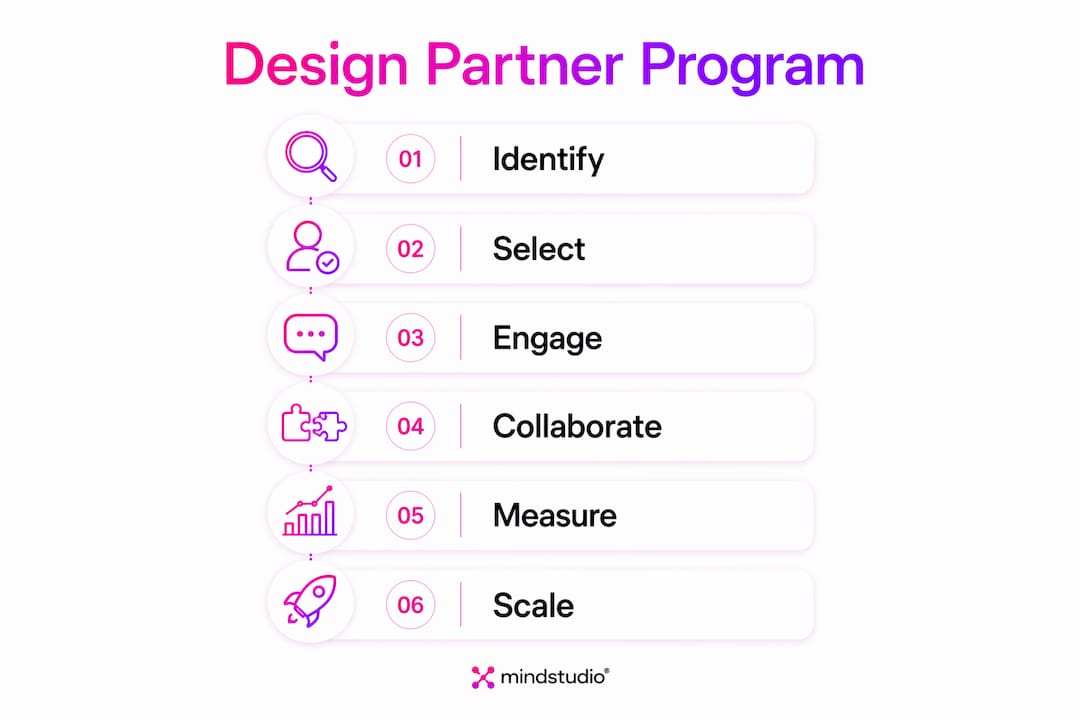
For recruitment, cold outreach is actually a stronger signal than warm intros. Strella, an AI customer research platform, recruited all 12 of its design partners through cold LinkedIn outreach, deliberately skipping warm introductions. The logic: a stranger who says yes with no social obligation is a fundamentally more honest signal than a friend doing you a favor.
How to work effectively with design partners
Structure is what separates a productive design partnership from a polite beta that goes nowhere. Here’s what that structure actually looks like in practice.
Engagement cadence:
- Biweekly 30-minute synchronous calls focused on one specific question, not a status update marathon
- A dedicated async channel (Slack works well) for daily friction points and quick feedback
- Monthly deep-dives on strategic questions, future use cases, and willingness-to-pay signals
Program length matters more than most founders realize. Two months tends to be the sweet spot: long enough to build trust and get real usage data, short enough to maintain urgency. Go longer and you risk building features nobody asked for. Go shorter and you haven’t built enough trust for honest feedback.
On contracts: yes, you need one. A well-structured design partner agreement covers scope boundaries, time commitments, feedback cadence, discount terms, and a fixed conversion price at signing. That last part is critical. Negotiating price at month six, under deal pressure, is a nightmare you can avoid entirely by naming the number upfront.
| Element | Typical Terms |
|---|---|
| Synchronous commitment | 1–4 hours per month of decision-maker time |
| Async feedback | Weekly written updates via dedicated channel |
| Discount range | 30–90% off list, or free during design phase |
| Program length | 3–12 months, with a hard end date |
| Conversion mechanic | Fixed price named at signing, binary decision at term end |
Design partnerships also double as a masterclass in enterprise sales. You learn buying cycles, budget approval processes, and who actually holds the budget. That intelligence is worth as much as the product feedback itself.
Pro Tip: Talk pricing early, even if it feels awkward. Even a broad range like “$30–50K annually” sets expectations and prevents the painful surprise conversation later when you ask them to pay.
Common pitfalls and how to avoid them
The design partnership model breaks down in predictable ways. Here’s where founders usually go wrong (and how to not be that founder).
- The free consulting trap: Indefinite free access is not a design partnership. It’s an advisory relationship with no conversion signal. Without hard termination or conversion terms, partnerships drift past month seven, month nine, month twelve, and you’re still getting feedback from someone who has never made a buying decision.
- Scope creep from custom integrations: A partner asks for a custom integration. You build it in three to five engineering weeks. It ships, and no other prospect needs it. The pattern repeats with partners two and three. Name the scope boundary in the agreement, and treat out-of-scope requests as either a paid statement of work or a deferred roadmap item.
- Optimizing for sentiment over conversion: Conversion is the only real success metric, not positive feedback on a call. Enthusiastic responses feel great. They are not evidence of product-market fit. Willingness to pay is.
- Choosing quantity over quality: Ten deeply engaged skeptics beat fifty polite supporters every time. You need people who use the product daily, break it, and push you to fix it.
- Hiding from commercial conversations: Skipping early pricing discussions leads to awkward transitions and stalled partnerships later. Bring it up early, even if the product barely exists.
Well-run programs that enforce conversion deadlines and clear scope boundaries see conversion rates in the 30–60% range. That’s the forcing function the end-of-term clause creates.
What Coumba Win Design knows about making partnerships work
At Coumba Win Design, the design partnership model isn’t just a concept we explain. It’s how we actually work with founders. Bold, outcome-oriented design only lands when it’s built around real product context, and that context comes from structured collaboration with the people who will actually use what you’re building.
A few things we’ve seen make or break these partnerships:
- Align design with commercial goals from day one. The best partnerships treat branding, UX, and product direction as one conversation, not three separate tracks. When a founder working on an educational platform came to us, the design work wasn’t just about aesthetics. It was about reducing friction in the user journey in ways that directly tied to retention metrics.
- Set creative boundaries early. Open-ended creative briefs produce open-ended feedback loops. Defining what the design partnership will and won’t cover keeps collaboration focused and prevents the “can you also just…” requests that quietly consume engineering and design time.
- Use feedback to sharpen brand narrative, not just fix bugs. Design partners often surface positioning insights that no survey would catch. A high-end apparel brand we worked with used partner feedback to refine their brand story in ways that made their pitch to wholesale buyers dramatically more effective.
Pro Tip: Treat every design partner conversation as a brand research session. The language your partners use to describe the problem is often the exact language your future customers will respond to in marketing copy.
The best design partnerships produce two things at once: a better product and a sharper story about why that product exists. When those two outputs align, you’re not just building something people want. You’re building something people can explain to their colleagues, their bosses, and their investors.
For founders who want to go deeper on how design partners drive startup growth, the mechanics of prototyping and gathering feedback on early product versions are worth understanding before your first partner kickoff call.
How do you measure the ROI of a design partnership?
Conversion rate is your north star, but it’s not the only number worth tracking. A well-run program produces measurable outputs across several dimensions.
Conversion to paid is the primary signal. Pricing models should emerge from what you learn about how partners actually buy, not from internal spreadsheets. Strella’s seat-based pricing model came directly from watching how organizations approved and controlled spending during their design partner program, and the company reached $1.6M ARR in its first year of monetization.
Beyond conversion, track these:
- Feedback quality: Are partners describing problems in concrete business terms, or just saying “looks good”? Specificity is the signal.
- Usage without prompting: Partners who return to the product on their own, without founder follow-up, are showing genuine pull.
- Reference willingness: A partner who converts and agrees to a case study is worth more than five who convert quietly. Converted partners become reference customers, case studies, and proof points for every deal that follows.
- Pricing intelligence: Did the partnership reveal what buyers will actually pay, how they budget, and who approves the spend?
For UX and usability research methods that complement design partner feedback, structured usability testing between synchronous calls can surface friction points that partners wouldn’t think to mention unprompted.
Legal considerations and IP ownership
This is the part founders skip until it becomes a problem during due diligence. Don’t do that.
The biggest risk with informal design partnerships is IP ambiguity. If your co-creators have only signed a letter of intent (LOI), you have a problem. LOIs have no legal impact on IP ownership, and when a fundraising or acquisition process asks you to prove you own the IP in your product, tracking down a design partner from two years ago who has since changed jobs is a nightmare scenario.
A proper design partner agreement should explicitly cover:
- IP ownership: The startup retains product IP. Any custom code built during the partnership should be scoped and agreed in writing.
- Confidentiality: A mutual NDA covering roadmap details and pre-release builds, typically for 2–3 years from disclosure.
- Reference rights: Agree at signing that conversion triggers case study participation and reference call availability. Negotiating this post-conversion is harder than it sounds.
- Data rules: Define data sources, access levels, storage, and retention before the first working session, especially if the partner’s data is involved in training or testing.
The IP ownership clause should survive termination. Even if the partnership ends early, you need that assignment in place.
How to scale your design partnership program as you grow
Your first cohort of 3–7 partners is a learning exercise. Scaling means turning those learnings into a repeatable system.
The transition point is when your product works without custom configuration for at least three distinct use cases, your sales team can demo to a cold prospect without founder involvement, and the majority of your design partners have converted to paid contracts. At that point, you graduate from co-development mode to standard sales motion, with partners moving to regular pricing (at their locked-in discount).
Scaling the program itself means:
- Formalizing the cohort structure. Move from ad hoc partner recruitment to a defined intake process with clear qualification criteria and a fixed program calendar.
- Systematizing feedback collection. What worked as a Slack channel and biweekly call for five partners breaks down at fifteen. Structured async interviews and aggregated reporting keep signal quality high as volume increases.
- Protecting the roadmap. As partner count grows, the risk of one loud voice dominating product direction increases. Weight feedback across the full cohort, not just the most engaged partner. Understanding scalable business model principles helps here, particularly around how to structure partner tiers as the program matures.
- Transitioning reference assets. Each converted partner should produce a case study within 60 days of conversion. Building this into the agreement at signing, rather than chasing it afterward, is what produces a referenceable logo library at scale.
What communication tools actually work for ongoing collaboration
The tools matter less than the cadence, but the wrong tools will kill your cadence.
The framework that works for most programs combines synchronous and async channels with clear ownership on both sides:
- Synchronous: A recurring 30-minute call (Zoom or Google Meet), same day and time each week or biweekly. One agenda item, not a status update marathon. The founder or product lead owns the agenda; the partner owns the feedback.
- Async: A dedicated Slack channel or equivalent for daily friction points, quick reactions to shipped features, and anything that doesn’t need a meeting. Set response-time expectations on both sides in the agreement.
- Shared documentation: A living roadmap doc where partners can see upcoming priorities and vote on what matters most. Transparency here builds trust faster than almost anything else.
- Structured feedback forms: After each major feature ship, a short written async update from the partner. “What worked, what didn’t, what would make this worth adopting” is a three-question format that produces usable signal without requiring a call.
The vague “we’ll send you our thoughts” commitment produces approximately zero structured feedback over a six-month engagement. Named channels, named cadences, and named owners produce consistent signal you can actually act on.
Key Takeaways
A startup design partnership model works when conversion, not sentiment, drives every structural decision from day one.
| Point | Details |
|---|---|
| Partners differ from beta users | Design partners shape a product before it’s built; beta users test one that already exists. |
| Cohort size matters | Aim for 3–7 partners: enough for diverse signal, few enough to manage deeply. |
| Contracts prevent scope creep | Fix pricing, scope, and conversion mechanics at signing, not under deal pressure at month six. |
| Skeptics outperform believers | Skeptical power users give more honest feedback and become stronger advocates once convinced. |
| Conversion is the only real metric | Willingness to pay, not positive sentiment, is the signal that validates product-market fit. |
Ready to build your first design partnership?
If you’re a founder who sees design as a competitive advantage (and you should), Coumba Win Design works with early-stage startups as a true design partner, not just a vendor. Bold branding, product UX, and platform development built around your actual growth goals.
Visit Coumba Win Design to see how we work and what we’ve built with founders like you.
FAQ
What is a design partner in a startup?
A design partner is an early target customer who co-develops your product before it’s fully built, providing structured feedback in exchange for early access and discounted pricing, with the expectation of converting to a paying customer at the program’s end.
How many design partners should an early-stage startup have?
The ideal range is 3–7 partners. Fewer than three risks building for an edge case; more than ten fragments feedback and makes iteration harder.
How long should a design partnership last?
Most programs run 3–12 months, with two months often cited as the sweet spot for maintaining urgency while building enough trust for honest, actionable feedback.
Do you need a contract with design partners?
Yes. A design partner agreement should cover scope, time commitments, feedback cadence, discount terms, IP ownership, and a fixed conversion price at signing to prevent scope creep and ambiguous termination.
What is the difference between a design partner and a beta user?
Beta users test a finished product. Design partners shape a product that doesn’t fully exist yet, influencing roadmap, pricing architecture, and go-to-market strategy through structured co-creation over a defined program period.
Recommended