Cross-Functional Design Collaboration That Drives Outcomes

Cross-Functional Design Collaboration That Drives Outcomes
Cross-functional design collaboration is the practice of bringing designers, product managers, engineers, QA, and stakeholders into a shared design process so that every decision moves toward a measurable user or business outcome rather than just a finished deliverable. Done right, it cuts rework, shrinks time-to-market, and produces products people actually want to use. Thoughtworks frames this shift clearly: empathy and shared user research are what turn design from a siloed visual output into a team-owned outcome. At Coumba Win Design, Coumba Evelyn has seen this play out repeatedly with startup clients, and the pattern is consistent: teams that align before they build ship faster and fix less.
Key Takeaways
Cross-functional design collaboration works when teams align on a shared outcome metric before development starts, use async tools to replace slow handoffs, and make decision rights explicit from day one.
| Point | Details |
|---|---|
| Align before you build | Define one outcome metric and publish a RACI in the first two weeks. |
| Use async critiques | Loom walkthroughs plus Figma comments replace most synchronous review meetings. |
| Make decision rights explicit | A decision log and RACI prevent endless consensus loops and stalled sprints. |
| Measure cycle time and fix rate | Track post-release fixes and cycle time from day one to prove collaboration is working. |
| Coumba Win Design | Offers three-phase alignment workshops and retained design support for startups moving from outputs to outcomes. |
Table of Contents
- Why cross-functional design collaboration matters for your product
- What principles make cross-functional teamwork in design actually work?
- Concrete practices that make collaboration work day to day
- Who decides what? Roles, responsibilities, and governance
- How do you know if cross-functional collaboration is actually working?
- Common collaboration failure modes and how to fix them fast
- A three-phase roadmap to adopt cross-functional design alignment
- How Coumba Win Design applies this in a real client engagement
- The part most teams skip (and why it costs them)
- Coumba Win Design accelerates your cross-functional alignment
- Sources
- FAQ
Why cross-functional design collaboration matters for your product
The core argument is simple: outputs (screens, specs, decks) are easy to produce; outcomes (faster onboarding, lower churn, higher task success) require everyone pulling in the same direction. MasterClass notes that collaborative design phases, from ideation through revision, generate stronger client buy-in and measurably better user experience results.
The business case stacks up quickly:
- Fewer change requests. When engineering and QA participate in design critiques, mismatches surface in Figma, not in production.
- Faster time-to-market. Parallel feedback loops replace sequential handoffs, compressing review cycles.
- Stronger product/market fit. Shared user research means the whole team builds from the same evidence, not competing assumptions.
- Higher innovation rate. Diverse perspectives in early ideation generate solutions no single discipline would reach alone.
A literature review on design collaboration confirms that teamwork and digital modalities are the two most studied drivers of collaborative success, even as researchers note that a single definitive framework has yet to emerge. That gap is actually good news for practitioners: it means the field rewards teams that build their own disciplined practice rather than waiting for a universal playbook.
What principles make cross-functional teamwork in design actually work?
The five non-negotiables are: empathy, shared user research, outcomes over outputs, transparency, and psychological safety. Get these right and the tools almost don’t matter. Skip them and no amount of Figma or Miro will save you.
Empathy is the starting point. Thoughtworks calls it the “essential currency” of cross-functional teams: without it, engineers optimize for build speed and designers optimize for aesthetics, and neither group is optimizing for the user.
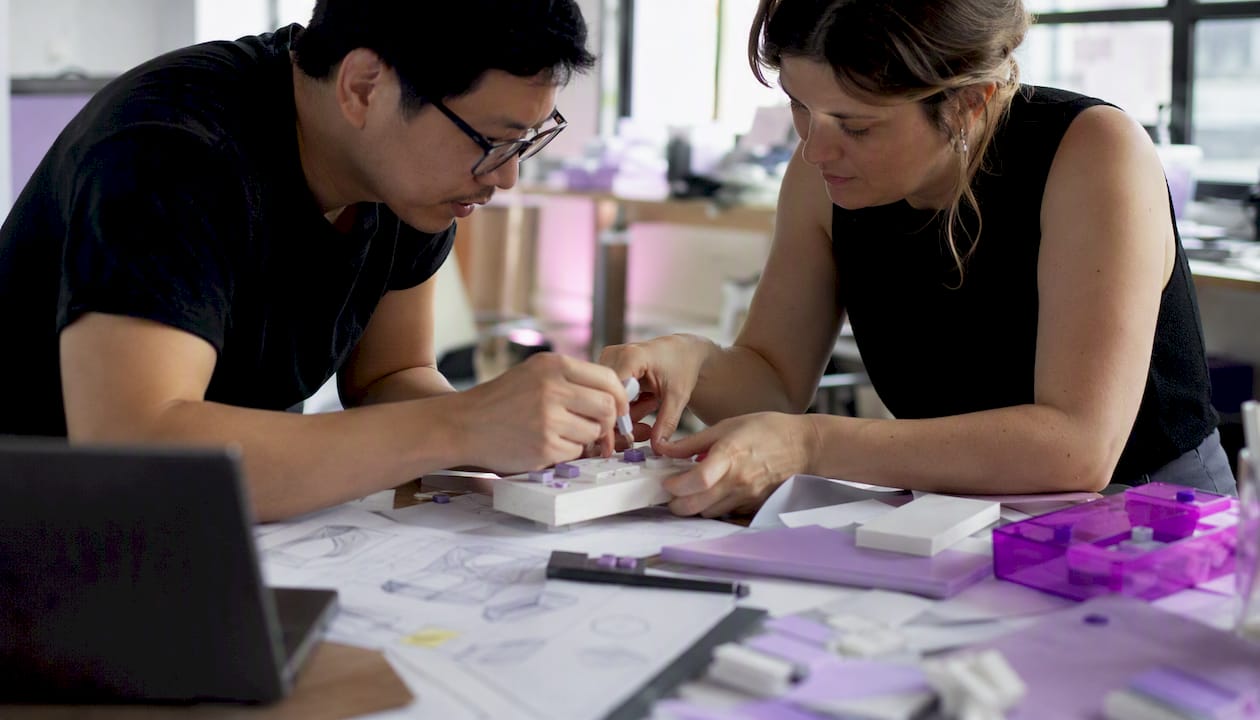
Shared user research is what makes empathy operational. When a PM, a designer, and an engineer all watch the same usability session, they stop arguing about whose interpretation is correct.
Outcomes over outputs is the mindset shift that changes everything. A team that ships a feature is not done; a team that moves a metric is. Frame every sprint goal around a user behavior or a business KPI, not a deliverable count.
Transparency keeps the process honest. Shared decision logs, open Figma files, and visible revision histories mean no one is surprised by a direction change at the eleventh hour.
Building that safety takes deliberate effort: short retrospectives, explicit norms around feedback, and leaders who model vulnerability by asking questions rather than issuing directives.
Concrete practices that make collaboration work day to day
The most effective cross-team design strategies combine joint sketching, async critiques, structured playbacks, and shared research artifacts. Here is how to run each one:
- Joint sketching session (30 minutes). Gather design, PM, and one engineer. Sketch three rough solutions to the same user problem. No polish, no judgment. The goal is shared understanding, not a final design.
- Async design critique via Loom + Figma. The designer records a Loom walkthrough of a Figma frame, narrating decisions and open questions. Reviewers leave timestamped comments in Figma. No meeting required.
- Structured playback. At the end of each sprint, the designer presents the design rationale (not just the visuals) to the full team. Engineering confirms feasibility; QA flags edge cases; PM confirms alignment with the outcome goal.
- Shared research artifacts. Store interview notes, usability findings, and personas in a shared Miro board or Notion space. Anyone on the team can reference them before making a decision.
Tool quick-reference:
- Figma: live design, inline comments, and version history for the whole team
- Loom: async video walkthroughs that replace synchronous review meetings
- Miro: workshop facilitation, affinity mapping, and shared research boards
- InVision: annotated prototype feedback and stakeholder sign-off flows
Cloud-enabled platforms like these support real-time markup and revision control, which is what makes distributed cross-functional teams viable.
Feedback request template (copy this): Decision log template (copy this): Pro Tip: Start with Minimum Viable Practices. Run one 30-minute joint sketch before your next sprint. That single ritual, recommended by Thoughtworks, teaches you more about your team’s collaboration gaps than any process audit.
Who decides what? Roles, responsibilities, and governance
Make decision rights explicit at project kickoff. Nielsen Norman Group is direct on this: unclear roles are one of the top reasons collaboration fails, and the fix is structural, not cultural.
A simple RACI keeps things honest:
Acceptance criteria bullets every team should define before a design moves to development:
- User can complete the primary task in under [X] steps
- Design passes WCAG 2.1 AA accessibility checks
- Edge cases for empty states and error flows are documented
- Engineering has confirmed feasibility within sprint capacity
How do you know if cross-functional collaboration is actually working?
Track these five outcome metrics: cycle time (days from design start to dev-ready), post-release fix rate (bugs tied to design ambiguity), task success rate (from usability testing), NPS or CSAT delta (before and after a redesigned flow), and time-to-value (how quickly a new feature moves a target metric).
Set baselines in week one. Run weekly demos to surface blockers early. Monthly outcome reviews compare the metrics against the baseline and inform the next sprint’s priorities.
Measurement checklist:
- [ ] Baseline cycle time recorded before the pilot starts
- [ ] Post-release fix rate tracked per sprint
- [ ] Usability test scheduled within two weeks of launch
- [ ] NPS or CSAT survey tied to the redesigned flow
- [ ] Monthly review cadence on the calendar
UX research drives these decisions most reliably when it is shared across the team rather than siloed in a research report no one reads.
Common collaboration failure modes and how to fix them fast
These patterns explain why most cross-functional efforts stall, and each one has a fast fix.
- Silos: Design ships comps without PM or engineering input. Fix: add one engineer to every design critique.
- Poor feedback culture: Feedback is vague (“make it pop”) or personal. Fix: use the feedback request template above; require specific, outcome-referenced comments.
- No shared research: Each function builds from its own assumptions. Fix: run one joint research session per quarter; store findings in a shared Miro board.
- Unclear roles: Decisions get relitigated because no one owns them. Fix: publish a RACI on day one and log every major decision.
- Remote/async friction: Time zones kill synchronous rituals. Fix: default to async Loom critiques; reserve live meetings for decisions only.
One-week quick-action checklist:
- Publish a RACI for the current project
- Record one Loom walkthrough instead of scheduling a review meeting
- Move research artifacts to a shared Miro board
- Add one engineer to the next design critique
- Set a baseline for cycle time and post-release fix rate
A three-phase roadmap to adopt cross-functional design alignment
Forbes recommends a three-phase approach: Align (weeks 1–2), Prototype (weeks 3–6), and Scale (weeks 7+). Each phase has a clear output and a short checklist.
| Phase | Duration | Primary Activities | Measurable Output |
|---|---|---|---|
| Align | Weeks 1–2 | Shared research session, RACI, decision log setup, outcome goal definition | Agreed outcome metric and documented decision rights |
| Prototype | Weeks 3–6 | Joint sketching, async Loom critiques, Figma playbacks, acceptance criteria | Dev-ready prototype with sign-off from all functions |
| Scale | Weeks 7+ | Repeat rituals, measure cycle time and fix rate, refine RACI | Reduced cycle time, lower post-release fix rate |
Phase checklists:
Align: Run joint research session. Define one outcome metric. Publish RACI. Set up decision log.
Prototype: Run 30-minute joint sketch. Record Loom critique. Hold structured playback. Confirm acceptance criteria.
Scale: Review cycle time monthly. Adjust RACI as team grows. Onboard new functions with the same rituals. Track design asset governance as the library grows.
How Coumba Win Design applies this in a real client engagement
A startup client came to Coumba Win Design with a fragmented product: the design team was shipping screens, but engineering kept rebuilding them after launch because the acceptance criteria were never defined. The outcome goal was clear (reduce post-launch rework by aligning design and engineering before a single line of code was written), but the process to get there was not.
Coumba Win Design ran the three-phase alignment model: a shared research session in week one surfaced the user problems everyone agreed on; Loom walkthroughs replaced three weekly review meetings; Figma playbacks gave engineering a single source of truth with version history. By the end of the prototype phase, the team had a documented decision log, a RACI, and a dev-ready prototype with sign-off from PM, engineering, and QA.
Artifacts used:
- Shared Miro board with research findings and affinity map
- Figma file with inline comments and version history
- Loom walkthroughs for async critique
- Decision log and RACI published in Notion
The prototyping process was the pivot point: once engineering could interact with a real prototype, the number of “but what happens when…” questions dropped sharply because the answers were already in the file.
The part most teams skip (and why it costs them)
The importance of collaborative design is not really about tools or even process. It is about who is in the room when the problem gets defined. Most teams bring engineering in after the design is “done” and then wonder why there are so many change requests. The fix is not a better handoff document; it is an earlier invitation.
The three-phase model works because it forces alignment before anyone writes a line of code. But the teams that get the most out of it are the ones that treat the Align phase as a genuine discovery process, not a box-checking exercise. That means sharing raw research, not polished summaries. It means letting an engineer say “that interaction is going to be expensive to build” in week two, not week eight.
Psychological safety is the piece that makes this possible. And it is not soft: teams with high psychological safety surface problems earlier, which is a direct cost reduction. The editorial content workflows that work best in media and brand teams follow the same logic: the earlier a cross-functional voice enters the process, the fewer expensive revisions happen at the end.
Coumba Win Design accelerates your cross-functional alignment
Coumba Win Design gives startup teams a faster path from scattered deliverables to measurable product outcomes, without the overhead of a traditional agency engagement.
The work is structured around the same three-phase model described in this article: a shared research and alignment session, a prototype phase with async Loom critiques and Figma playbacks, and a scale phase with governance artifacts your team keeps. Services include workshops, pilot engagements, design playbooks, and retained design support, all built for founders who treat design as a competitive advantage. Whether you need a one-time alignment sprint or an ongoing design partner, the engagement is scoped to your stage and your outcome goal.
Ready to move your team from outputs to outcomes? Coumbawin and let’s scope your pilot.
Sources
- Design as a team — Thoughtworks
- Crossfunctional Collaboration: Challenges and Strategies for Success - NN/G
- What is Collaborative Design? — SOLIDWORKS
- How to Use Design Reviews for Cross-Team Collaboration — Atlassian (Loom guest post)
- The Cross-Functional Blueprint: How design-first engineering improves software development — Forbes
- Critical review of design collaboration literature — ScienceDirect
- Design collaboration guide: 3 benefits of collaborative design — MasterClass
FAQ
What is cross-functional design collaboration?
It is the practice of involving design, product, engineering, QA, and stakeholders in a shared design process so that decisions are driven by a common outcome goal rather than individual function priorities.
How do you improve design collaboration on a distributed team?
Default to async Loom walkthroughs and Figma inline comments for critiques, and reserve live meetings for decisions only. Nielsen Norman Group recommends explicit role clarity as the single highest-leverage fix for distributed collaboration failures.
What tools support cross-functional design workflows?
Figma handles live design and version history; Loom enables async video critiques; Miro supports workshops and shared research boards; InVision manages annotated prototype feedback and stakeholder sign-off.
How do you measure whether design collaboration is working?
Track cycle time (days from design start to dev-ready), post-release fix rate, and task success rate from usability testing. Set baselines before the pilot starts and review monthly.
How does Coumba Win Design support cross-functional alignment?
Coumba Win Design runs three-phase alignment engagements (align, prototype, scale) for startups, including shared research sessions, async critique workflows, and governance artifacts like decision logs and RACIs.
Recommended