Startup Website Cost: What to Budget in 2026
Startup Website Cost: What to Budget in 2026
So you need a website, and every quote you’ve seen is somewhere between “a pizza” and “a used car.” Fair. Here’s the short version: a startup website typically costs about $200 a year if you build it yourself, $1,500 to $8,000 with a freelancer, and $6,000 to $35,000 or more with an agency, according to SiteGround’s 2026 cost guide. Then there’s upkeep after launch, which most first-time founders forget to budget for. 😅
We design and build startup websites for a living, so we’ve seen every flavor of “wait, why does that cost so much?” Let’s walk through what you’re paying for, where the money goes, and how to pick a number that makes sense for your stage.
TL;DR
- Who builds your site moves the price more than any feature: DIY is about $200 a year, freelancers run $1,500 to $8,000, and agencies $6,000 to $35,000 or more (SiteGround, 2026).
- Page count, custom design, integrations, and who writes the content are the big levers once you’ve picked a builder.
- Budget for life after launch: a small business site often runs roughly $600 to $6,000 a year in total ongoing costs.
- Your website is also an investor-facing asset, so a bargain build that undersells you can cost more than it saves.
- Decide by stage: pre-launch, seed, or scaling each call for a different level of investment.
Table of Contents
- What startups actually pay: the ranges at a glance
- Who builds it matters more than what’s on it
- What pushes your price up (or down)
- The costs after launch
- Our take: why we think design belongs in the budget, not the “nice to have” pile
- How to set a budget that fits your stage
- Working with Coumba Win
- FAQ
- Sources
What startups actually pay: the ranges at a glance
The numbers online look chaotic because they mix very different things: a one-page landing page, a five-page brochure site, a full web app. Once you sort by who builds it, the picture gets clearer.
| Route | Typical cost | Best for |
|---|---|---|
| DIY site builder | $16 to $50 per month | Validating an idea, a simple landing page |
| Self-hosted WordPress (DIY) | $100 to $500 per year | Founders comfortable with some tinkering |
| Freelancer | $1,500 to $8,000 one time | A defined site with a clear scope |
| Boutique or full agency | $6,000 to $35,000 and up | Brand-led, growth-focused sites |
| Custom web app or MVP | A few hundred dollars (no-code) to $18,000 and up (custom) | Products, not just marketing sites |
All figures come from SiteGround’s 2026 guide. Other guides publish different ranges (some push agency work well past $15,000 for custom builds), which is normal: there’s no standard price list for “a website.” Treat every range as a map, not a quote.
For a concrete example, the same SiteGround guide prices a five-page brochure site at around $200 a year built yourself, about $4,000 from a freelancer, and $12,000 or more from an agency. Same five pages. Very different deal.
Who builds it matters more than what’s on it
Here’s the thing that surprised us when we first started comparing quotes: the biggest price jump isn’t about features. It’s about what you’re buying on top of the pixels.
As SiteGround puts it, at the high end of the range you’re not buying more website. You’re buying judgment, accountability, and time savings. That framing is useful for founders, because your own time is the scarcest resource you have.
DIY and no-code
Builders are great when speed and cost matter most. You can have something live this weekend. The trade-off is your time and a ceiling on how distinctive the result can look. If your site is a placeholder while you find product-market fit, this is a perfectly sensible route.
Freelancers
A good freelancer is a strong middle path when the scope is clear: a handful of pages, a defined style, a launch date. You’ll usually manage the project yourself, though, including content, feedback rounds, and anything that falls between disciplines (brand, copy, development, SEO).
Agencies and design partners
This is where strategy, brand, UX, and build sit under one roof. The price is higher because the work is broader: someone is thinking about how the site supports your pitch, your hiring, your sales conversations, and your next round. If design is part of how you compete, that’s the point.
What pushes your price up (or down)
Once you’ve chosen a route, SiteGround lists the main cost drivers: design originality, page count and feature complexity, who writes the content, user roles and data logic, and ongoing costs. In startup terms, here’s how that plays out.
Design originality
A template with your logo swapped in is cheap. A custom design built around your story, audience, and product is not. We’re biased, but we’d argue custom is where startups get the most leverage, since a lookalike site makes you look like everyone else in your category. If you want to see what that looks like in practice, our post on custom web development benefits for startups goes deeper.
Page count and structure
Every page needs design, content, and QA. A simple site (home, product, about, pricing, contact) is a very different project than one with a blog, a resource library, case studies, and landing pages for each customer segment.
Features and integrations
A contact form is easy. A demo booking flow wired to your CRM, a customer portal, gated content, or a pricing calculator is more work. Interactive pieces can be worth it when they earn their keep; we’ve collected interactive website features that convert so you can decide which ones are worth paying for.
Content
Who writes the words? If you hand over finished copy, the build is faster. If you need messaging, storytelling, and copy developed, that’s real additional work. It’s also the part founders most often underestimate.
Branding and investor-facing needs
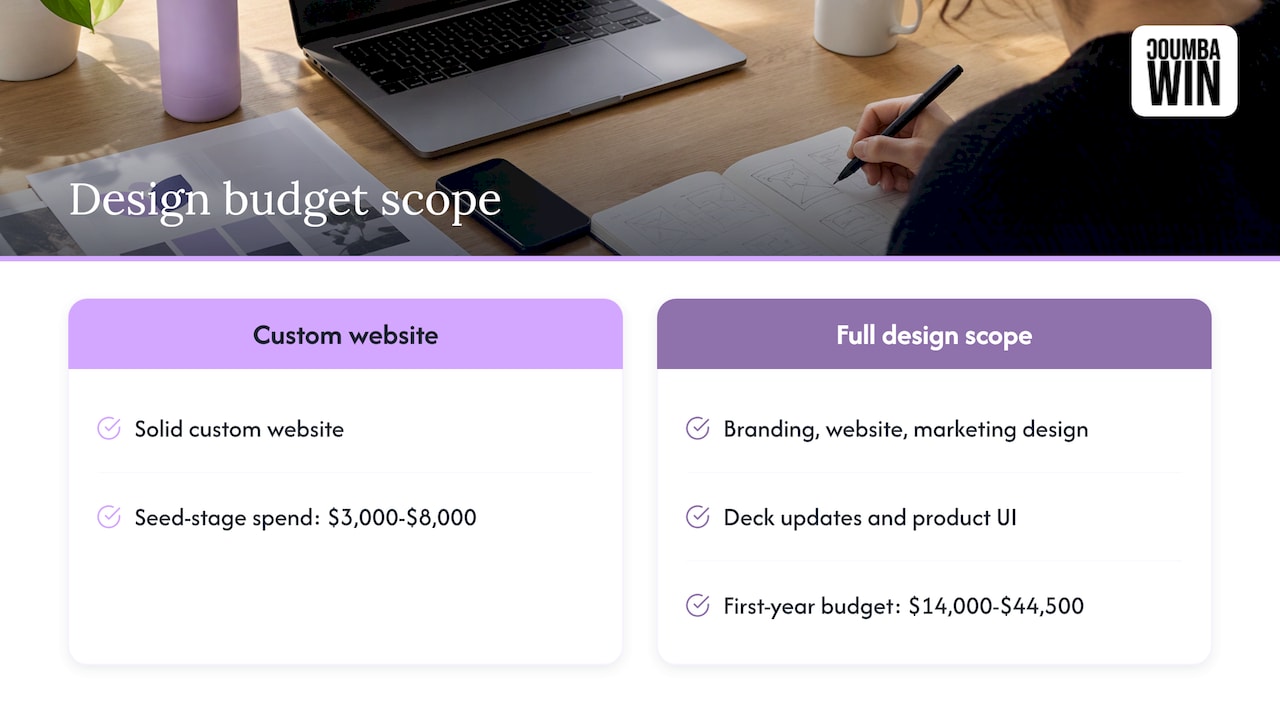
Startups rarely need “just a website.” You may also need a logo, a visual identity, a pitch deck that matches, and product UI that feels consistent. One design-focused industry guide (Kapa99) estimates that most seed-stage startups spend $3,000 to $8,000 on a solid custom website, and a first-year design budget of $14,000 to $44,500 when branding, website, marketing design, deck updates, and product UI are all included. Use that as a sense-check of how quickly the “website” line grows once the whole brand is in scope, not as a price list.
The costs after launch
This is the part nobody puts in the pitch deck. Your site isn’t done when it goes live. It needs a domain, hosting, security, updates, and eventually changes.
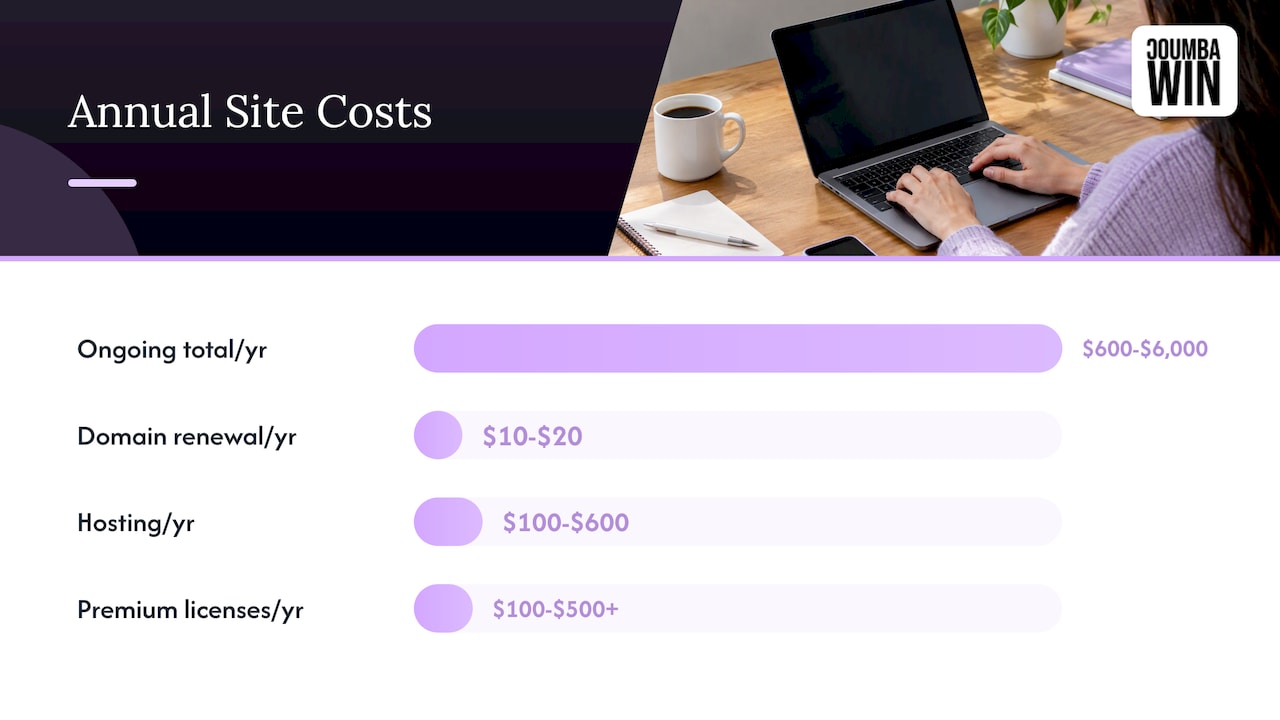
SiteGround notes that a small business site has roughly $600 to $6,000 in total ongoing costs a year, with full-service maintenance plans commonly costing $95 to $195 per month. If the site is simple and you handle updates yourself, domain and hosting alone can come in well under $100 a year.
Here’s how the individual pieces tend to break down, per Elementor’s 2026 cost guide:
- Domain renewal: $10 to $20 per year
- Hosting: $100 to $600 per year
- Premium plugin or theme licenses: $100 to $500 or more per year
- Professional maintenance: $50 to $200 per month
If you’re on WordPress, DreamHost estimates about $415 for the first year of a business site, counting hosting (around $240 a year), a domain (around $15 a year), a premium theme ($20 to $100 once), and plugins ($0 to $200 a year).
And if you publish often, content becomes a recurring line too. On WordPress, WordPress publishing automation can take some of the repetitive publishing work off your plate, which is one more cost that’s easy to forget when you’re only thinking about the build.
A separate rule of thumb you’ll see around: budget a slice of a custom build’s price every year for maintenance, often quoted at 15% to 20%. It’s a planning heuristic, not a law, but it’s a nice reminder that a $10,000 site isn’t a one-time $10,000.
Can a website be free?
Sort of. Free tiers from site builders exist, but they typically come with trade-offs like a subdomain instead of your own domain, ads, limited storage, and no e-commerce. Fine for a test page. Less great when an investor Googles you at 11 p.m. before a meeting. 🙃
Our take: why we think design belongs in the budget, not the “nice to have” pile
We’ll say the quiet part out loud: we’re a design partner, so of course we think good design is worth paying for. But here’s why we believe it, beyond the obvious.
Founders come to us stressed about price, and we get it. The number matters. What we try to do first is flip the question from “how cheap can this be?” to “what is this site supposed to do for the business?” If it needs to convince investors, win your first ten customers, or make a hiring pitch land, the site is part of how you compete.
That’s why we don’t hand out generic templates or AI-generated design. Your site should look like your company and nobody else’s. We work closely with founders, scope the work around real growth goals, and build things that can scale with you: a brand, a site, a pitch deck, and later email, SEO, and ads, all speaking the same language.
Our advice for most early teams: start with the pages that carry the most weight (home, product, story, contact), build them well, and expand once you have data. A focused, polished site beats a sprawling, half-finished one every time.
Coumba Evelyn
How to set a budget that fits your stage
Here’s a simple way to work through it without a spreadsheet meltdown.
- Name the job of the site. Is it to collect waitlist signups, support a fundraise, convert demos, or recruit? One primary job keeps scope honest.
- List the must-have pages and features. Anything else goes on a “phase two” list.
- Decide who writes the content. If it’s you, set aside real time. If it’s us or another partner, include it in scope.
- Pick your route by stage. Pre-product: a lean builder or freelancer site is often enough. Seed or post-seed with fundraising and hiring ahead: a custom, brand-led site starts paying for itself in credibility.
- Add the after-launch line. Hosting, domain, maintenance, and a small pot for changes. Use the ranges above.
- Leave room for the unexpected. New feature requests, an extra landing page, a rebrand tweak. A modest buffer saves arguments later.
Want to dodge the expensive rework? Our list of common startup website design pitfalls covers the mistakes that tend to force a second build. And if you’re still gathering ideas, our portfolio website examples for startups can help you decide what’s worth paying for.
What to ask before you sign anything
- What exactly is included: pages, revisions, content, integrations?
- Who owns the design files and the site when it’s done?
- Is hosting included, and what happens at renewal?
- What does support look like after launch, and what does it cost?
- How will you handle changes that fall outside the original scope?
Clear answers here matter more than the headline price. A cheap quote with fuzzy scope often ends up costing more than a clear one.
Working with Coumba Win
We’re a design partner for startups, and website design and development is core to what we do. Our team also handles UI and UX design, Webflow development, pitch deck design, accessibility audits, SEO optimization, email marketing, and ad management, so your site and everything around it can come from one team that already knows your story.
Pricing depends on scope, so we don’t publish a flat rate. The fastest way to get a real number is to tell us what you’re building and by when.
See our full range of web design and development services, or check out our Webflow development work to see how we build for fast-scaling startups.
FAQ
How much does a startup website cost?
It depends mostly on who builds it. SiteGround’s 2026 guide puts DIY at about $200 a year, freelancers at $1,500 to $8,000, and agencies at $6,000 to $35,000 or more. Seed-stage startups often land in the low-to-mid thousands for a solid custom site, with more if branding and product UI are in scope.
How much does it cost to run a startup website each year?
The simple version is domain and hosting, which can come in well under $100 a year on a very basic setup. A small business site with maintenance and plugins more commonly runs roughly $600 to $6,000 a year in total, per SiteGround. Your number depends on how much you handle yourself.
Is it worth paying for a custom website as an early-stage startup?
If your site is part of how you win customers, talent, or investors, usually yes. A template can get you live, but a custom site tells your specific story and gives you room to grow. If you’re still testing the idea, a lean launch page is a sensible first step, and you can invest further once you have traction.
What costs do founders forget?
Content, maintenance, and plugin or theme renewals top the list. Copywriting, photography, and product visuals are often not in the base quote. After launch, expect recurring hosting, domain renewal, security and update work, and occasional design changes.
Can I start cheap and upgrade later?
Yes, and many startups do. The trick is to plan the migration: choose a platform you won’t outgrow in six months, keep your content organized, and keep brand assets consistent so a later redesign builds on what you have instead of starting over.
So what’s the number you’re working with? Tell us your budget and your timeline, and we’ll tell you honestly what’s possible. 🚀 #StartupLife #WebDesign #FounderTips