Website Redesign Cost: What Startups Really Pay in 2026
Website Redesign Cost: What Startups Really Pay in 2026
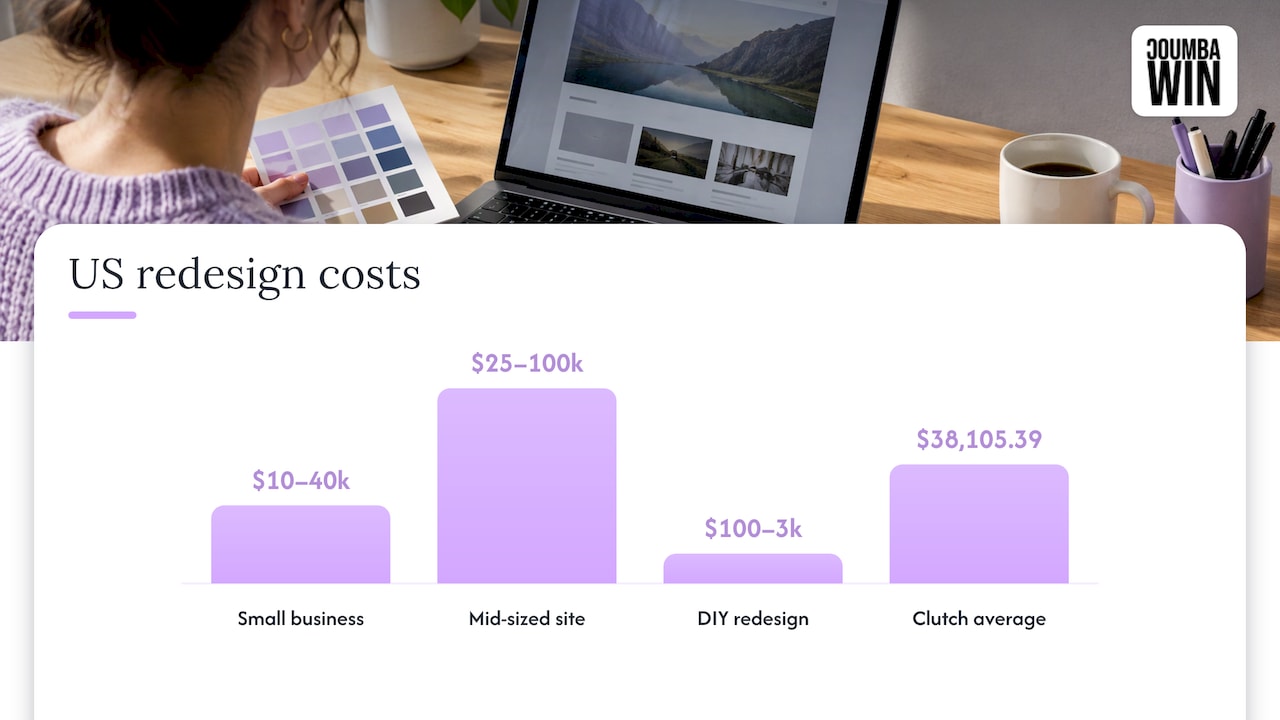
Most US small businesses pay somewhere between $10,000 and $40,000 to redesign a website, and the project usually takes three to four months, according to Converto’s 2026 cost breakdown. Mid-sized sites run higher, and ecommerce or enterprise rebuilds start around $40,000 to $50,000. DIY can cost a few hundred dollars. Agencies can cost many thousands more.
That’s a wide range, I know. (Nobody enjoys hearing “it depends.”) So this guide shows what the number depends on, how to guess your own, and where budgets quietly blow up. Grab a coffee. We’ll keep it painless. ☕
TL;DR
- A small-business redesign typically lands at $10,000 to $40,000; mid-sized sites run $25,000 to $100,000, and ecommerce or enterprise projects start near $40,000 to $50,000.
- DIY runs roughly $100 to $3,000, freelancers $2,000 to $20,000+, and agencies $15,000 to $30,000+, depending on complexity.
- Add-ons (photography, video, copywriting) and yearly maintenance are the line items most budgets forget.
- Plan for three to four months for a typical small-business project, and longer if content or approvals drag.
- Scope drives price more than anything else: pages, custom features, content and migration work.
Table of Contents
- What a website redesign costs in the US
- DIY, freelancer or agency: how the cost changes
- What actually moves the price
- The add-ons that surprise people
- How long a redesign takes
- How to estimate your own budget
- Perspective: why we push for custom design
- Work with us on your redesign
- FAQ
- Sources
What a website redesign costs in the US
Here are the figures reported by the sources we trust most for this, side by side:
| Project type | Typical US cost | Source |
|---|---|---|
| Small business redesign | $10,000 to $40,000 | Converto, September 2026 |
| Mid-sized site | $25,000 to $100,000 | Converto |
| Ecommerce or enterprise | From about $40,000 to $50,000, past $250,000 | Converto |
| DIY redesign | $100 to $3,000 | HubSpot, 2023 |
| Agency | $15,000 to $30,000+ | HubSpot |
| Large, complicated site | $40,000 to $75,000 or higher | HubSpot |
One more data point for perspective. Clutch’s pricing guide, which draws on tens of thousands of agency profiles and client reviews, puts the average project at $38,105.39, with a typical timeline of seven months. It also notes that most reviewed projects cost under $10,000, which tells you the average is pulled up by large builds. Averages are a fun party fact. They’re a terrible budget.
The HubSpot figures date from 2023, so treat them as a floor and expect today’s quotes to sit at or above them.
DIY, freelancer or agency: how the cost changes
The same redesign can cost 10x more or less depending on who does it. What changes is not just the invoice but what you get for it.
DIY
HubSpot pegs a DIY redesign at roughly $100 to $3,000. That covers templates, a platform subscription and maybe a few stock images. You pay with your own hours, and the result tends to look like everyone else’s template. For a startup that wants its site to be a competitive edge, that’s the real cost.
Freelancer
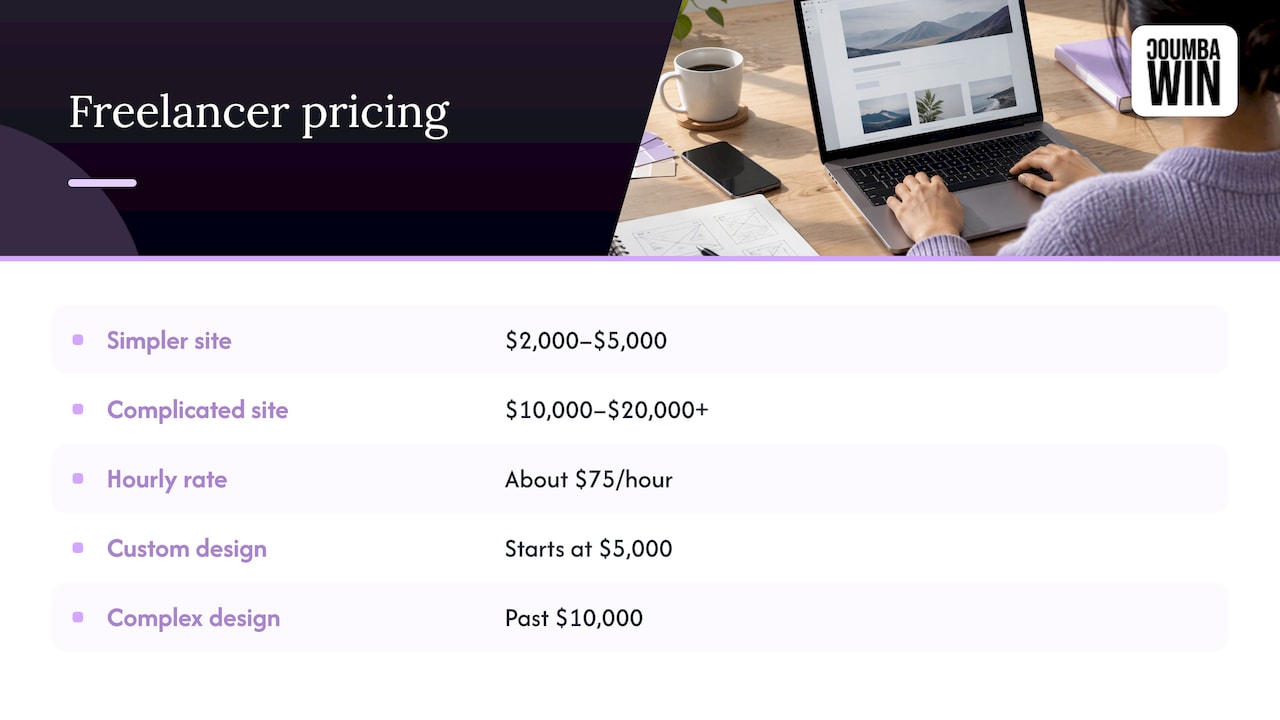
The same HubSpot guide says freelancers charge about $2,000 to $5,000 for a simpler site and $10,000 to $20,000 or more for a complicated one. Hourly, FreshBooks reports that web designers typically charge about $75 an hour, and that a custom website design usually starts at a minimum of $5,000, going past $10,000 for complex projects. A freelancer can be a great fit for a tight scope. The catch is that strategy, development, content and SEO then have to be stitched together by you.
Agency or design partner
HubSpot lists agencies at $15,000 to $30,000+. Clutch reports a US design rate of $100 to $149 per hour. What you’re buying is a team: strategy, UX, visual design, development and launch under one roof, with someone accountable for the result.
What actually moves the price
Every quote is a stack of decisions. These are the ones that matter most.
- Number and type of pages. A five-page marketing site and a 200-page catalog are different species. Every unique template needs design, development and testing.
- Custom design vs. template. Starting from a template is cheaper up front. A fully custom design costs more because someone is solving your specific problems instead of reusing someone else’s.
- Functionality. Booking, a customer portal, payments, integrations with your CRM. Each one adds design and development hours.
- Content. New copy, photography and video are often priced separately from the build (more on that below).
- Research and strategy. Interviews, analytics review and user testing add time at the start and save you from rebuilding the wrong thing.
- Migration and SEO. Redirects, URL mapping and content moves protect the traffic you’ve already earned.
- Accessibility. Designing for it from the start is far cheaper than patching later.
If your site already ranks, migration is where costs hide. A site migration SEO checklist walks through mapping URLs so you keep rankings, and our own first SEO site migration checklist is written for startups doing this for the first time.
The add-ons that surprise people
This is the part of the budget that makes founders say “wait, that’s extra?” Converto’s figures give a useful sense of scale:
| Add-on | Typical cost |
|---|---|
| Custom photography | $3,000 to $15,000 |
| Video | $5,000 to $25,000 per video |
| Copywriting | $100 to $300 per page |
| Annual maintenance | 15 to 20 percent of the build cost, every year |
Source: Converto.
Do the math on copy alone: a 25-page site at $100 to $300 a page is $2,500 to $7,500 before anyone designs anything. And a $30,000 build with 15 to 20 percent maintenance means roughly $4,500 to $6,000 a year to keep it healthy.
Video is the add-on with the most options. If a hero video is on your wish list, a look at AI video production costs shows what per-clip pricing can look like next to traditional production.
How long a redesign takes
The same source says a typical small-business redesign takes three to four months. Clutch’s agency data shows a seven-month typical timeline across all project sizes, which includes bigger builds.
Time is money here. Delays are rarely about design. They’re about slow feedback, content that shows up late and too many people approving. If you want a week-by-week view, our website design timeline for founders covers what happens in each phase.
How to estimate your own budget
You don’t need a quote to get a ballpark. Try this in about 20 minutes.
- Pick your tier. Small business, mid-sized, or ecommerce/enterprise, using the table above.
- List your pages. Count unique templates (home, service, blog post, pricing), not just total pages.
- Add the extras. Copy per page, photography, video, special features.
- Add the migration work. If you have traffic worth protecting, budget for redirects and testing.
- Add 15 to 20 percent a year for maintenance. It’s easy to skip and painful to forget.
- Add a cushion. Scope grows. A buffer keeps one extra feature from turning into a budget fight.
Then get two or three scoped proposals and compare what’s included, not just the bottom line. Two $25,000 quotes can mean very different things.
A worked example
Say you’re a seed-stage startup with a 12-page site and a blog. You pick the small-business range, $10,000 to $40,000. You need new copy for 12 pages ($1,200 to $3,600 at $100 to $300 a page), and no video yet. You’d budget the build, the copy and a maintenance line for next year. The numbers add up fast, which is exactly why scope conversations happen first.
Perspective: why we push for custom design
We work with startups every day, and the pattern is hard to miss: founders who treat design as a business advantage get more from every dollar they spend on it.
That’s why we steer clear of generic templates and AI-generated design. Our approach is built around working closely with founders, so the site solves your specific growth problem, whether that’s converting investors, onboarding users or explaining a complicated product in ten seconds.
A redesign isn’t a cosmetic exercise for us. It’s branding, UX, development, SEO and sometimes accessibility, all pulling in one direction. When those pieces are planned together, you avoid paying twice for rework, and you launch something built to scale with you.
Our advice on budget: spend where your customers and investors actually look. Put your money into clear messaging, a flow that makes sense, and a build that can grow. Then add polish once the foundation holds.
Coumba Evelyn
Work with us on your redesign
We’re a design partner for startups, and we cover branding, web design and development, UI and UX design, Webflow development, SEO optimization, accessibility audits, email marketing and more. We don’t publish prices because every project is scoped to what you actually need. If you’re weighing a redesign, see our web design and development services or take a look at our Webflow development work.
Want to know what a redesign could do for the business side first? Our piece on the business impact of a website redesign is a good starting point, and common startup website design pitfalls is worth a skim before you brief anyone.
FAQ
How much does a website redesign cost for a small business?
Most US small businesses land between $10,000 and $40,000, according to Converto. Simpler sites built by freelancers can come in lower, and sites with custom features, large content libraries or ecommerce cost more.
How much does it cost to pay someone to design your website?
Freelance designers typically charge about $75 an hour, and a custom design usually starts at around $5,000, per FreshBooks. Agencies are generally priced higher because they bundle strategy, design, development and launch support.
How long does a website redesign take?
Plan on three to four months for a typical small-business project. Larger or more complex builds take longer, and late content or slow approvals are the usual cause of slipped launch dates. Our website design timeline breaks it into phases.
Is a redesign cheaper than starting from scratch?
Not automatically. A redesign still involves strategy, design and development, and you may also need migration work to protect existing search traffic. What you gain is the content, brand and rankings you already have, if they’re handled carefully.