Human-Centered Design for Startups: A Founder's Growth Guide

Human-Centered Design for Startups: A Founder’s Growth Guide
Run a one-week discovery sprint or brief a strategic design partner this week. That’s the verdict. Human-centered design (HCD) follows three core phases: inspiration (research), ideation (prototyping), and implementation. It’s the fastest way founders reduce product risk before committing engineering budget. If you need fast validation, buy a sprint. If you need continuous brand and product alignment, hire a retained partner. Either way, start before you build.
Key Takeaways
HCD reduces startup risk most when it’s treated as a validation discipline tied to measurable KPIs, not a visual exercise.
| Point | Details |
|---|---|
| Start with a sprint | A 1-week discovery sprint validates assumptions before any engineering budget is committed. |
| Demand full deliverables | Every SOW should include a Style Guide, Components library, prototype, and accessibility audit. |
| Set KPIs before signing | Define 3–5 measurable KPIs upfront so every deliverable maps to a business outcome. |
| Hire for process, not portfolio | Ask for research samples and post-launch metrics; skip agencies that lead with visual comps only. |
| Coumba Win Design | Runs discovery sprint through full design system handoff via the Win The Web engagement model. |
Table of Contents
- Why applying human-centered design is your startup’s best risk-reduction move
- What does the HCD process look like for a fast-moving startup?
- Which HCD methods and deliverables should you actually demand?
- What timelines and costs should you budget for?
- How do you evaluate and hire the right strategic design partner?
- How do you onboard an agency and keep the engagement on track?
- How do you measure whether HCD work is actually paying off?
- What mistakes do founders make when applying HCD?
- What results does Coumba Win Design actually produce?
- What’s the honest take on HCD for startups?
- Coumba Win Design is the strategic design partner built for founders like you
- Sources
- FAQ
Why applying human-centered design is your startup’s best risk-reduction move
HCD is not a creative luxury. It’s a discipline that keeps you from spending six months building something users don’t want (we’ve all seen that startup graveyard). Organizational design maturity correlates with stronger revenue growth and total returns than peers who treat design as an afterthought. The business case is pretty hard to argue with.
Here’s what HCD actually buys you as a founder:
- Lower rework costs. Fixing a design issue before engineering is dramatically cheaper than patching it post-release. Classic software research consistently finds that post-release fixes are many times more expensive than early corrections.
- Higher activation rates. Research-first onboarding flows convert better because they’re built around what users actually need, not what you assumed they needed.
- Stronger investor demos. A clickable prototype that’s been tested with real users tells a much better story in a pitch than a static deck.
- Faster product-market fit. Iterative validation cycles compress the feedback loop so you’re not waiting for a full launch to learn you were wrong.
Treating design as strategic from day one creates durable differentiation and trust. That’s not a soft claim. It’s the difference between a product that feels inevitable and one that feels like a committee built it.
What does the HCD process look like for a fast-moving startup?
Five phases, adapted for speed. Here’s how they map to startup reality:
A few things worth calling out:
- Figma is the standard for prototyping and handoff. Annotated files with design tokens are what engineering teams actually need.
- Journey maps don’t have to be fancy. A simple sticky-note flow that captures the user’s emotional state at each step is enough to surface the friction points worth fixing.
- The prototype-to-test loop is the core mechanism. Iterative prototyping and testing builds confidence and reduces late-stage rework in ways that no amount of internal debate can replicate.
Which HCD methods and deliverables should you actually demand?
Research first, then prototype fast. That’s the priority order. Practical HCD methods for startups include user interviews, jobs-to-be-done mapping, low-fidelity wireframes, clickable prototypes, and quick usability tests. Here’s how they sequence:
- Several user interviews → problem map that surfaces real pain points (not your assumptions)
- JTBD mapping session → clarity on what users are actually hiring your product to do
- Low-fi wireframes → fast concept validation before any pixel-perfect work
- Clickable prototype → 5-user usability test that catches critical friction before engineering
- Accessibility audit → catches WCAG compliance gaps before launch, not after
When you’re writing an SOW or RFP, demand these deliverables in writing:
- Research summary with key findings
- Journey maps (emotional + functional)
- Wireflows showing key user paths
- Clickable prototype (Figma)
- Design system tokens and a Style Guide
- Components library (reusable UI elements, developer-ready)
- Accessibility audit report
Any agency that can’t hand you all of these is leaving you with incomplete work. Research-first engagements with measurable deliverables are how agencies demonstrate real ROI to founders.
What timelines and costs should you budget for?
The shape of the engagement determines what you should buy:
| Sprint type | Duration | Primary output | Best for |
|---|---|---|---|
| Discovery sprint | 1 week | Problem map, research summary | Validating a hypothesis fast |
| Design sprint | 2–4 weeks | Clickable prototype + test report | Pre-engineering validation |
| MVP definition | 8–12 weeks | Full design system + handoff specs | Pre-seed to seed-stage builds |
| Ongoing retainer | Monthly | Continuous iteration + brand alignment | Post-launch scaling |
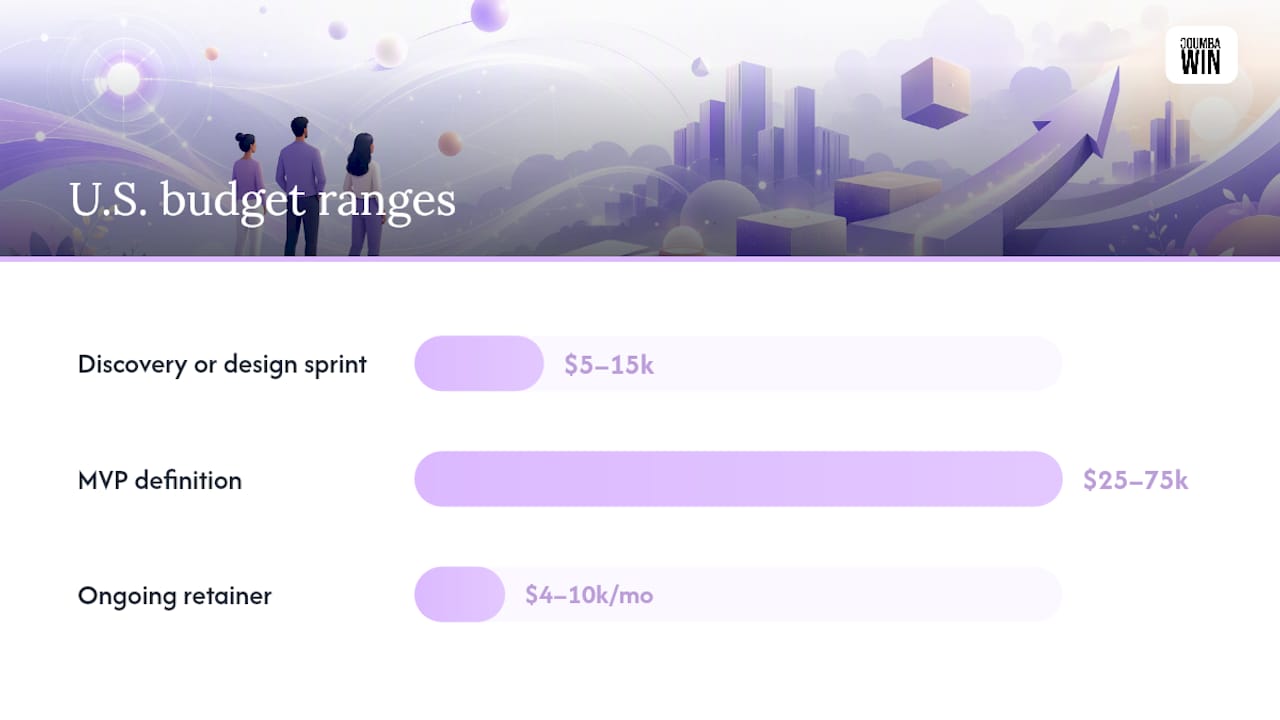
For U.S.-based startup engagements, ballpark ranges run from roughly $5,000–$15,000 for a scoped discovery or design sprint, $25,000–$75,000 for an MVP definition engagement, and $4,000–$10,000 per month for a retained design partner. These are ranges, not invoices. Scope, complexity, and team size all move the number.
Pro Tip: Set 3–5 measurable KPIs before you sign anything, then map each deliverable to at least one of those KPIs. If a deliverable doesn’t connect to a metric you care about, it probably doesn’t belong in the SOW.
How do you evaluate and hire the right strategic design partner?
Hire for process and outcomes, not portfolio aesthetics. A beautiful portfolio with no research samples is a red flag. Agencies must do research before producing high-fidelity designs — any partner who skips straight to visual comps is skipping the part that actually reduces your risk.
Ask these questions in every agency interview:
- “Walk me through a project where research changed the design direction.”
- “What does your handoff package include? Can I see a sample Figma file?”
- “How do you measure success after launch?”
- “What’s your process if usability testing reveals the prototype isn’t working?”
Red flags to walk away from:
- No research phase in the proposal
- Only visual comps, no wireflows or prototypes
- Missing handoff artifacts (no tokens, no annotated specs)
- Vague timelines with no milestone checkpoints
- Can’t name a single post-launch metric from a past project
Coumba Win Design, led by Coumba Evelyn, operates exactly this way. The Win The Web engagement model runs from discovery sprint through MVP definition, delivering a complete design system including Style Guide, Components, and annotated handoff files. Strong branding built on research is what separates founders who close their Series A from those still iterating on their homepage.
How do you onboard an agency and keep the engagement on track?
A disciplined kickoff is the single biggest predictor of smooth delivery. Scope drift and engineering rework almost always trace back to a weak kickoff, not a weak agency.
- Share context docs before day one. Business model, target personas, competitive positioning, and any existing analytics access. Agencies perform best when the client has defined objectives upfront.
- Define success metrics together. Agree on 3–5 KPIs in the kickoff meeting, not after the first sprint.
- Set a weekly sync cadence. Thirty minutes, every week. Sprint demos at the end of each phase.
- Assign a single internal point of contact. Decision-making by committee kills momentum.
- Schedule handoff milestones explicitly. Annotated Figma files, design tokens, and QA support during engineering are non-negotiable checkpoints, not afterthoughts.
To embed HCD practices into your team long-term, run a short internal workshop after the first sprint. Walk your PM and engineering lead through the research findings and prototype decisions. That context is what prevents the “but why did we design it this way?” conversations six months later. Managing design assets consistently as you scale keeps the system from fragmenting.
How do you measure whether HCD work is actually paying off?
Pick 3–5 KPIs tied to the business goal before work begins. Not after. Here’s a practical mapping:
| Deliverable | Primary KPI to track |
|---|---|
| Onboarding flow redesign | Onboarding completion rate |
| Prototype + usability test | Task success rate / error rate |
| Style Guide + Components | Design-to-dev handoff cycle time |
| Accessibility audit | WCAG compliance score |
| Brand identity system | Brand recall / NPS |
For reporting cadence: weekly show-and-tell during a sprint, monthly reviews for a retainer. Ask your agency for a simple dashboard that tracks these metrics against baseline. Design-mature companies show stronger business outcomes over time, but you need a baseline to see the delta.
What mistakes do founders make when applying HCD?
Most failures come from skipping validation and treating design as surface-level cosmetic work. Here’s the hit list:
- Skipping user research entirely. Fix: run 5 interviews before any design work starts. One afternoon of conversations will change your assumptions.
- Mistaking UI polish for UX. A beautiful interface with broken flows still fails. Fix: test flows with real users, not just screenshots with stakeholders.
- Waiting until launch to test. Fix: test the prototype, not the live product. Catching friction at prototype stage costs a fraction of post-launch fixes.
- No handoff artifacts. Fix: require annotated Figma files, tokens, and a components library in every SOW.
- Ignoring accessibility. Fix: include a WCAG audit in every engagement. It’s cheaper than retrofitting and protects you legally.
What results does Coumba Win Design actually produce?
Two quick examples of what HCD-driven design work looks like in practice:
Educational platform UX overhaul. The challenge was a high drop-off rate in the core learning flow. Coumba Win Design ran a discovery sprint, mapped the user journey, and rebuilt the onboarding experience using a new Components library and Style Guide. The result was a measurably smoother activation path. (Detailed metrics and founder testimonials available on request.)

High-end apparel brand narrative. The brand lacked a coherent visual identity across digital touchpoints. Coumba Win Design delivered a complete Win The Web engagement: brand strategy, visual identity system, and a website built on the new Style Guide and Components. The brand narrative became consistent and conversion-focused across every channel.
— Coumba Evelyn, Design Partner at Coumba Win Design
What’s the honest take on HCD for startups?
HCD gets oversold as a feel-good process and undersold as a business tool. The founders who get the most out of it are the ones who treat it like financial modeling: rigorous, evidence-based, and tied to a number. The ones who struggle are the ones who run one round of user interviews, feel validated, and never test again.
The other thing nobody says loudly enough: connecting branding, UX, and product strategy into a cohesive narrative is genuinely hard. It requires a partner who thinks in systems, not screens. Most agencies deliver screens. A strategic design partner delivers a system that scales with you, and that’s a completely different engagement.
Coumba Win Design is the strategic design partner built for founders like you
You’ve got the roadmap. Now you need a partner who can actually execute it without making you babysit the process. Coumba Win Design runs a discovery sprint → MVP definition → full design system handoff, delivering Style Guide, Components, annotated Figma files, and QA support. No fluff, no mystery deliverables. The Win The Web engagement starts with a scoped discovery call where you define your KPIs and we map the sprint to them. Pricing models include fixed-scope sprints, project-based engagements, and monthly retainers. You pick the model that fits your runway. Visual storytelling and brand narrative are baked into every engagement, not bolted on at the end.
Book your discovery call at Coumbawin and walk away with a scoped sprint plan in one session.
Sources
The sources below back the claims in this guide and offer deeper reading for founders ready to go further.
- Using Human-Centered Design to Create Better Products (with Examples)
- Tingyu Su on why AI startups should treat the founding designer as a strategic hire from the start of company building
- Product Design Services for Startups — Complete Guide
FAQ
What is human-centered design for startups?
Human-centered design for startups is a validation-first process that uses user research, prototyping, and iterative testing to reduce product risk before engineering begins. It follows three phases: inspiration, ideation, and implementation.
How long does an HCD sprint take?
A discovery sprint runs roughly one week; a full design sprint with prototype and usability testing takes 2–4 weeks. MVP definition engagements typically run 8–12 weeks.
What deliverables should I expect from an HCD engagement?
At minimum: a research summary, journey maps, a clickable prototype, a Style Guide, a Components library, annotated Figma handoff files, and an accessibility audit report.
How does Coumba Win Design apply HCD for startup founders?
Coumba Win Design runs a discovery sprint through full design system delivery, including Style Guide, Components, and engineering-ready Figma specs, via the Win The Web engagement model.
How do I measure whether HCD work is working?
Track 3–5 KPIs tied to specific deliverables: onboarding completion rate, task success rate in usability tests, design-to-dev handoff cycle time, and WCAG compliance score are the most direct signals.
Recommended