What Is Brand Identity Design? A Startup Founder's Guide

What Is Brand Identity Design? A Startup Founder’s Guide
Brand identity design is the deliberate creation of a coordinated system of visual and verbal elements that expresses what a business stands for, looks like, and sounds like across every touchpoint. It is not your logo. It is not your color palette. It is the full system that makes both of those things mean something. For entrepreneurs and startups, understanding this distinction is the difference between building a brand people recognize and trust versus throwing money at pretty graphics that do nothing for your growth.
What is brand identity design, and how does it differ from a logo?
Brand identity is the set of designed and controlled elements a business creates to express itself visually, verbally, and behaviorally. Brand image, by contrast, is what your audience actually perceives. You control identity. You influence image. That gap between the two is exactly what good brand identity design works to close.

Here is where most founders go wrong. They treat the logo as the whole identity. A logo is one receipt for a much larger set of decisions. As branding experts put it, a logo without supporting systems is decoration. Your identity can technically exist without a logo, but a logo without a system is just a pretty mark floating in a vacuum.
Three terms get mixed up constantly, so let’s sort them out fast:
- Brand identity is the full system: visual elements, verbal elements, behavioral guidelines, and the documented rules that hold them all together.
- Visual identity is a subset of brand identity. It covers the things you can see: logo, colors, typography, imagery, and graphic style.
- Brand image is what lives in your audience’s head. You shape it through identity, but you do not control it directly.
- Brand strategy is the thinking behind the identity. It defines your mission, values, positioning, and audience before a single design decision gets made.
Confusing these four concepts leads to the most common startup branding pitfall: spending $5,000 on a logo and calling it a day, then wondering why nobody recognizes you six months later.
What are the core elements of a brand identity system?
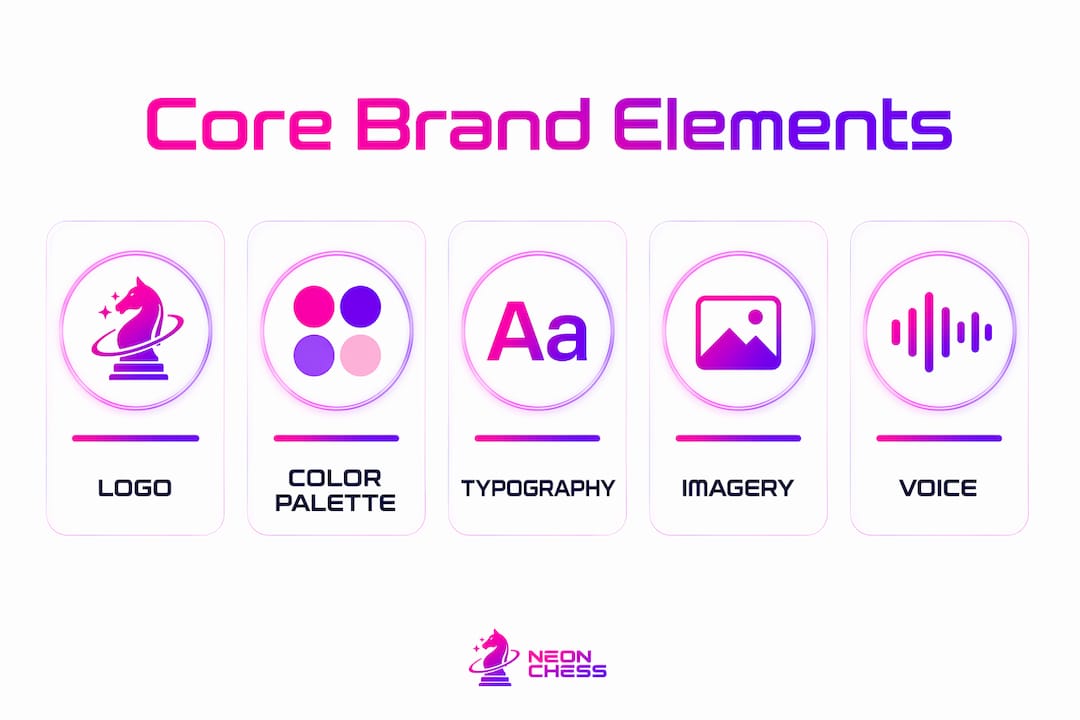
A complete brand identity system is made up of at least five interconnected elements. Key elements include the logo mark with all its variants, precisely defined color palettes with exact values, typography choices with clear hierarchy, imagery style direction, and verbal identity. Motion and sound are emerging as a sixth and seventh layer, especially for digital-first startups.
Here is what each element actually means in practice:
- Logo and mark variants. Your primary logo, secondary lockup, icon-only version, and reversed version for dark backgrounds. Each variant has a specific use case. Skipping variants means your team will improvise, and improvisation kills consistency.
- Color palette with exact values. Not “a shade of blue.” Hex codes for digital, Pantone for print, CMYK for offset printing. Without exact color codes, vendors eyeball colors and your brand looks amateurish across different media.
- Typography with hierarchy. A primary typeface for headlines, a secondary for body text, and clear rules about size, weight, and spacing. Typography carries personality. A serif font signals tradition and authority. A geometric sans-serif signals modernity and clarity.
- Imagery and graphic style. Photography direction (candid vs. staged, bright vs. moody), illustration style, and iconography rules. This is what makes your Instagram grid, pitch deck, and website feel like they belong to the same brand.
- Verbal identity. Verbal identity covers brand voice, tone, vocabulary, naming conventions, and storytelling approach. It is half of your brand identity and the half most startups completely ignore.
- Motion and sound. Animation style, transition behavior, and audio cues. These matter more every year as brands compete on TikTok, podcasts, and video-first platforms.
Pro Tip: Document your brand guidelines before you hire your first freelancer. A one-page style sheet with your hex codes, fonts, and logo files saves you from a painful rebrand six months later.
Why does brand identity design matter for startups?
Brand identity is a strategic asset, not an aesthetic preference. Consistent branding correlates with up to 33% revenue improvement in organizations that maintain it across all channels. That number comes from a 2019 Lucidpress survey, and it has only become more relevant as the number of touchpoints has multiplied.
Strong brand identity systems allow customers to recognize a brand in under a second, regardless of the touchpoint. That kind of instant recognition is not luck. It is the result of a deliberate, consistent system applied everywhere.
Recognition builds trust. Trust builds loyalty. Loyalty builds the kind of word-of-mouth that no ad budget can buy. For a startup with limited resources, that compounding effect is the whole game. You cannot afford to confuse people. Every inconsistent touchpoint is a small tax on your credibility.
The risk of logo-only branding is real. A startup that invests in a beautiful logo but skips the system ends up with a fragmented brand presence. The website looks different from the pitch deck. The social posts look different from the email newsletter. Customers sense the inconsistency even when they cannot name it, and it erodes trust quietly over time. Learning why startups need strong branding early is one of the highest-leverage investments a founder can make.
How can startups create and sustain an effective brand identity?
Building a brand identity from scratch follows a clear sequence. Skipping steps is how you end up redesigning everything eighteen months later.
- Start with brand strategy. Define your mission, values, target positioning, and the one thing you want people to feel when they encounter your brand. Design without strategy is guesswork dressed up nicely.
- Design the full system, not just the logo. Commission all logo variants, the complete color palette, typography pairings, imagery direction, and verbal guidelines at the same time. Piecemeal design produces piecemeal results.
- Test in real-world contexts. Testing brand elements across devices and print materials is non-negotiable. A color that looks great on your MacBook screen can look completely different on a printed brochure or a cheap Android phone.
- Write comprehensive brand guidelines. Brand guidelines are not bureaucracy. They are the document that lets anyone outside your original design team produce materials that keep your brand consistent and on-message.
- Assign a brand steward. Someone on your team owns brand consistency. Without a named owner, guidelines collect dust and everyone starts freelancing their own interpretation of your identity.
- Plan for iteration. Your brand identity should evolve as your company grows. Build the system to be extensible, not rigid.
Pro Tip: Before your brand guidelines go live, test your color palette for accessibility using a contrast checker. A palette that fails WCAG contrast standards will exclude users and create legal exposure.
The table below shows the most common brand identity mistakes and how to avoid them:
| Common mistake | What it costs you | How to fix it |
|---|---|---|
| Logo-only branding | Fragmented, unrecognizable presence | Commission the full system from day one |
| Missing exact color specs | Inconsistent colors across vendors | Specify hex, Pantone, and CMYK values |
| No verbal identity | Inconsistent tone across channels | Write a brand voice guide with examples |
| No brand guidelines document | Every new hire reinvents the wheel | Document rules before you scale |
| No brand steward assigned | Guidelines ignored within months | Name an owner and make it a real responsibility |
For a deeper walkthrough of the full process, the guide on how to build startup brand identity from scratch covers each phase in detail. And as your team grows, managing design assets becomes its own discipline worth investing in early.
Understanding brand consistency’s impact on growth is also worth your time, especially as you start thinking about scaling beyond your first 100 customers.
Key Takeaways
Brand identity design is a complete visual and verbal system, and startups that treat it as infrastructure rather than decoration build recognition, trust, and revenue faster.
| Point | Details |
|---|---|
| Identity is a system, not a logo | A logo without supporting elements is decoration; the full system creates recognition. |
| Exact specs prevent inconsistency | Always document hex, Pantone, and CMYK values to keep colors consistent across vendors. |
| Verbal identity is half the work | Brand voice, tone, and vocabulary shape perception as much as any visual element. |
| Guidelines enable scale | Written brand rules let any team member or vendor produce on-brand materials independently. |
| Consistency drives revenue | Consistent branding correlates with up to 33% revenue improvement, per the Lucidpress survey. |
Brand identity is infrastructure, not decoration
I have worked with enough founders to know the pattern by heart. You get excited about the logo. You spend weeks picking the perfect font. You obsess over whether the blue is “too corporate.” And then you launch with zero brand guidelines, no verbal identity, and a color palette that exists only in your designer’s head.
Six months later, your website, your pitch deck, and your social media look like they belong to three different companies. And you are back at square one, except now you have customers who are already confused.
The uncomfortable truth is that most startups underinvest in brand identity not because they do not care, but because they do not know what they are actually buying. They think they are buying a logo. They are actually buying a system that will carry their reputation across every single touchpoint for the next several years.
My honest advice: treat your brand guidelines document the same way you treat your cap table. It is a founding document. It defines how your company presents itself to the world. Get it right early, assign someone to own it, and update it deliberately as you grow. The startups that do this are the ones that look like they have been around for a decade even when they are eighteen months old.
— Coumba Evelyn
How Coumba Win Design helps startups build lasting brand identities
Coumba Win Design works directly with startup founders who know that design is a competitive advantage, not an afterthought. The work goes beyond logo creation. Coumba Win builds complete brand identity systems, including visual guidelines, verbal identity frameworks, and digital assets designed to scale with your company. Every engagement starts with strategy, so the design decisions actually connect to your business goals. If you are ready to build a brand that works as hard as you do, explore what Coumba Win offers and see how the right identity system can change how your market sees you.
FAQ
What is brand identity design in simple terms?
Brand identity design is the process of creating a coordinated system of visual and verbal elements, including your logo, colors, typography, and brand voice, that expresses what your business stands for and makes it recognizable.
How is brand identity different from a logo?
A logo is one component of brand identity. Brand identity is the full system of designed elements that work together to create consistent recognition across every channel and touchpoint.
What are the main elements of brand identity design?
The core elements are the logo with all its variants, a precisely defined color palette, typography with hierarchy, imagery and graphic style direction, and verbal identity covering voice, tone, and vocabulary.
Why does brand identity matter for startups specifically?
Startups have limited time to build trust with new audiences. A consistent brand identity creates recognition faster, and consistent branding correlates with up to 33% revenue improvement, making it one of the highest-return early investments a founder can make.
How do I know if my brand identity is working?
Your brand identity is working when customers recognize your materials instantly across different channels, when new team members can produce on-brand content without asking for help, and when your visual and verbal presence feels cohesive everywhere your brand appears.
Recommended