
Website Redesign Business Impact Explained for Owners

Website Redesign Business Impact Explained for Owners
A website redesign is a direct driver of brand perception, lead quality, and revenue growth when it is built on strategy rather than aesthetics alone. This is the website redesign business impact explained in one sentence: your site either converts visitors into customers, or it quietly bleeds opportunity. Most business owners treat a redesign like a coat of paint. The ones who win treat it like a product launch. The investment is real (costs typically run $35,000 to $120,000), and so is the payback when you get the strategy right.
What measurable business outcomes does a website redesign affect?
A redesign touches four business metrics that actually show up on your P&L: conversion rate, qualified lead volume, cost per acquisition, and average deal size. These are not vanity metrics. They are the numbers your CFO cares about.
Here is what moves when a redesign is done right:
- Conversion rate on primary goals (form fills, demo requests, purchases) is the single most important signal. A lift here compounds across all your traffic.
- Qualified lead volume improves when messaging clarity filters out poor-fit visitors and attracts the right ones.
- Cost per acquisition drops when organic traffic grows from technical SEO fixes baked into the redesign.
- Average deal size can increase when the site positions your offer at a higher perceived value through trust signals and case studies.
- Bounce rate and session duration are diagnostic, not primary. They tell you where friction lives, but they do not tell you if the business is growing.
Business outcomes improve only when these metrics move significantly over a meaningful post-launch window of about 90 days. Checking Google Analytics two weeks after launch and declaring victory is like reading a book’s first chapter and writing the review.
SEO visibility also responds to a redesign, but not in the way most owners expect. Core Web Vitals serve as multipliers rather than primary ranking factors. Fixing technical hygiene, improving content relevance, and cleaning up URL structure all compound over time. The organic traffic gains are real, but they take 60–90 days to register.
Strategy-driven vs. visual-only redesigns: what is the ROI difference?
This is where most business owners get burned. A visual refresh feels like progress. New colors, new fonts, a hero image that does not look like a stock photo from 2014. But the numbers tell a different story.

Strategy-driven redesigns deliver around 41% ROI improvement within six months and pay for themselves in 4–14 months. Visual-only redesigns average about 9% ROI over 12 months. That gap is not a rounding error. It is the difference between a redesign that funds itself and one that sits on the books as a sunk cost.
| Redesign type | Typical ROI improvement | Payback period |
|---|---|---|
| Strategy-driven (UX + conversion + technical) | ~41% within 6 months | 4–14 months |
| Visual-only (aesthetic refresh) | ~9% over 12 months | Often never fully recovered |
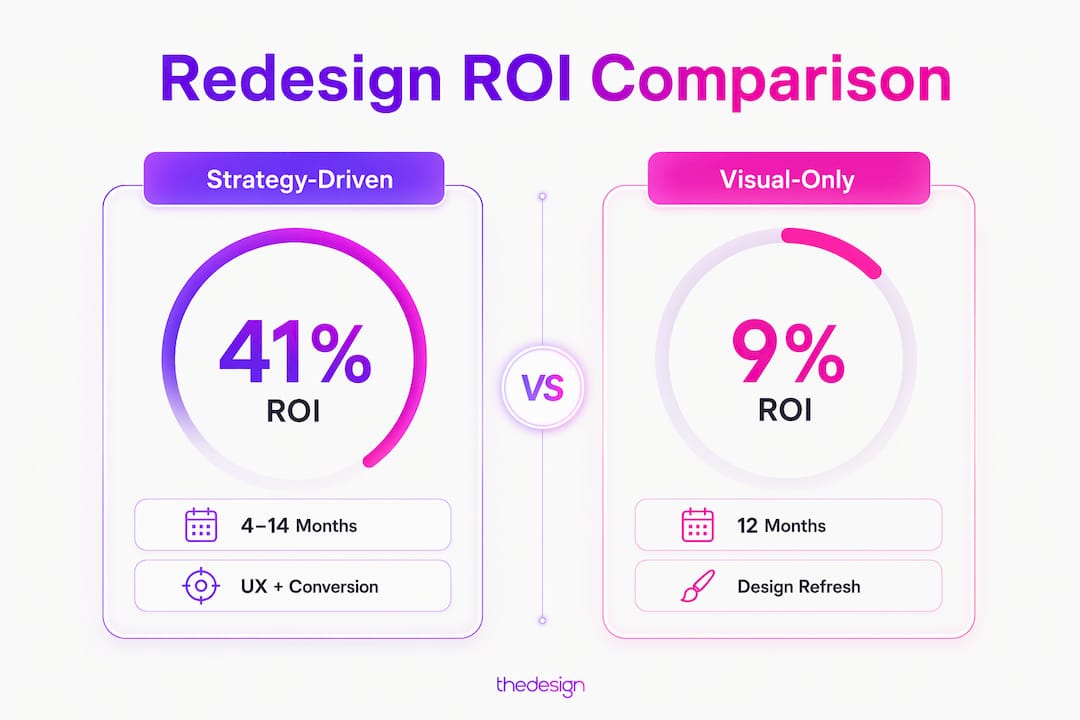
A strategy-driven redesign includes four components that a visual refresh skips entirely: UX architecture that maps to how buyers actually decide, conversion-focused page structure, content positioning that speaks to your buyer’s specific problem, and a technical foundation that does not penalize you in search.
Pro Tip: Before signing any redesign contract, write down the one metric you expect to move most. If the agency cannot explain exactly how their process will move that metric, keep looking.
The payback math is straightforward. Model your traffic, conversion rate, and average customer value to project what a 1% lift in conversion rate is worth annually. For a business with 5,000 monthly visitors and a $3,000 average contract value, that single percentage point is worth serious money. That is the conversation to have before you talk about color palettes.
Which technical and UX factors most critically influence redesign impact?
Speed matters, but it is not the whole story. Google’s Core Web Vitals set clear thresholds: Largest Contentful Paint (LCP) at or under 2.5 seconds, Interaction to Next Paint (INP) under 200 milliseconds, and Cumulative Layout Shift (CLS) under 0.1. Missing these thresholds hurts both rankings and user trust.
The factors that most directly influence business outcomes from a redesign are:
- Messaging clarity on the homepage: Visitors decide in seconds whether your site is for them. If your headline describes what you do instead of what the visitor gets, you are losing people before they scroll.
- Mobile responsiveness: More than half of B2B research now happens on mobile. A site that breaks on a phone is not a minor inconvenience. It is a closed door.
- Trust-building elements: Testimonials, case studies, client logos, and security signals all reduce the psychological friction that stops visitors from converting.
- Clear calls to action: Every page needs one primary action. Multiple competing CTAs create decision paralysis.
- URL structure and internal linking: These affect how search engines crawl and rank your content, and how visitors navigate to conversion points.
Shaving milliseconds from load time does not compensate for poor messaging and unclear navigation. Speed is table stakes. The real conversion work happens in the clarity of your brand message and the logic of your purchase pathway.
Real-user monitoring data captures true page performance under varied conditions. Lab scores from tools like Google PageSpeed Insights are useful starting points, but real-user measurement tells you what actual visitors experience on actual devices. That distinction matters when you are diagnosing why a technically “fast” site still has a high bounce rate.
How can you measure the real impact of a redesign post-launch?
Pick one primary KPI before launch. Not five. One. Everything else is context. Here is a practical post-launch measurement process:
- Establish a baseline before launch. Pull 90 days of pre-launch data on your chosen KPI. No baseline means no comparison, which means no proof.
- Track for at least 90 days post-launch. Measuring redesign success requires at least 90 days of post-launch data to filter out launch-day traffic spikes and seasonal noise.
- Integrate with your CRM. Google Analytics shows traffic behavior. Your CRM shows revenue behavior. Connect the two to see whether more visitors are actually becoming customers.
- Segment by traffic source. Organic, paid, and direct traffic respond differently to a redesign. A lift in organic conversions is a different story than a lift in paid conversions.
- Review secondary metrics as diagnostics. If your primary KPI is not moving, check bounce rate by page, session duration by entry point, and scroll depth to locate the friction.
Tools like Google Analytics 4, HubSpot, and Hotjar each serve a different layer of this analysis. GA4 tracks behavior at scale. HubSpot connects behavior to pipeline. Hotjar shows you exactly where visitors stop engaging. Used together, they give you a complete picture of how the redesign is performing against real business goals.
What practical guidance helps you plan a redesign for maximum impact?
Not every site needs a full redesign. A redesign is worth the investment when your current site has a structural problem: conversion architecture that does not match your buyer’s journey, technical debt that is suppressing organic traffic, or brand positioning that no longer reflects what you actually sell. If the problem is just that the site looks dated, incremental updates are cheaper and faster.
When a full redesign is the right call, plan for these realities:
- Budget for $35,000 to $120,000 for a service business redesign that addresses conversion, technical foundation, and strategy alignment. Lower budgets typically mean visual-only work with limited business impact.
- Plan for 3–6 months of transition disruption. Redirects, content migration, and team training all take time. Build that into your revenue projections.
- Use business unit economics to set expectations. Calculate what a realistic conversion rate improvement is worth in annual revenue. That number tells you whether the investment makes sense before you commit.
- Treat the launch as the starting line, not the finish line. The redesign is not done when the site goes live.
Websites should be treated as living assets, continuously evolving with new content, technical debt management, and iterative updates. The businesses that get the best long-term ROI from a redesign are the ones that keep optimizing after launch, not the ones that declare victory and move on.
Pro Tip: Schedule a 30-day, 60-day, and 90-day post-launch review with your design and marketing teams. Treat each review like a board meeting for your site. Bring data, not opinions.
The Coumba Win Design case study on Shell is a good example of what happens when redesign goals are tied directly to conversion outcomes rather than aesthetic preferences. The work does not stop at launch.
Key Takeaways
A strategy-driven website redesign delivers measurably better business outcomes than a visual refresh, with ROI improvements that pay back the investment within 4–14 months when conversion architecture, UX, and technical performance are all addressed together.
| Point | Details |
|---|---|
| Strategy beats aesthetics | Strategy-driven redesigns deliver ~41% ROI improvement vs. ~9% for visual-only updates. |
| Pick one primary KPI | Choose one metric tied to a business goal and track it for at least 90 days post-launch. |
| Speed is table stakes | Core Web Vitals compliance matters, but messaging clarity and navigation logic drive conversions. |
| Model the payback first | Use traffic, conversion rate, and average deal size to project ROI before committing to a budget. |
| Redesign is ongoing | Treat your site as a living asset with regular content, technical, and conversion updates post-launch. |
What I have learned from watching redesigns succeed and fail
I have seen founders spend $80,000 on a beautiful new site and watch their lead volume drop for three months. I have also seen a $45,000 strategy-led redesign pay for itself in under six months. The difference was never the design. It was whether the redesign started with a business question or a mood board.
The most common mistake I see is what I call “executive boredom redesign.” The CEO gets tired of looking at the old site, a new agency gets hired, and six months later there is a gorgeous new homepage that still does not explain what the company actually does for the buyer. The visual problem is solved. The conversion problem is not.
Conversion wins come from clarity and friction reduction throughout the user journey, not from speeding pages or adding animations. The sites that consistently perform well have one thing in common: every page has a clear job, and every element on that page supports that job. Nothing decorative. Nothing ambiguous.
My honest advice? Before you approve a single wireframe, write down the answer to this question: “What specific behavior do we want visitors to take, and what is stopping them from taking it right now?” If you cannot answer that, the redesign will be beautiful and ineffective. If you can, you have the brief that actually drives results.
— Coumba Evelyn
Coumba Win Design and strategy-led web redesigns
Coumba Win Design works with founders and business owners who want their website to function as a growth asset, not just a digital brochure. The focus is on conversion architecture, brand clarity, and technical performance working together.
If you are planning a redesign and want to see what outcome-focused design looks like in practice, the Coumba Win portfolio shows real examples of strategy-driven work across industries. For founders who also need pitch and marketing collateral aligned with their new brand direction, the Demo Day Kit delivers pitch decks, booth materials, and swag in 14 days. It is the fastest way to get your full brand presence launch-ready alongside a redesign.
FAQ
How much does a website redesign typically cost?
Service business redesigns typically cost $35,000 to $120,000, depending on scope, complexity, and whether the project includes strategy, UX, and technical work or just visual updates.
How long does it take to see ROI from a redesign?
Strategy-driven redesigns typically pay back in 4–14 months. Visual-only redesigns average about 9% ROI over 12 months, which often does not cover the investment.
What is the single most important metric to track after a redesign?
Track one primary KPI tied directly to a business goal, such as conversion rate or qualified lead volume, and measure it against a 90-day pre-launch baseline.
Does site speed alone improve conversions after a redesign?
No. Speed matters but does not compensate for poor messaging or unclear navigation. Conversion improvements require alignment of brand clarity, page structure, and purchase pathways.
When should a business choose optimization over a full redesign?
Choose optimization when the site’s structure and messaging are sound but specific pages underperform. A full redesign is warranted when conversion architecture, technical foundation, or brand positioning needs a structural fix.
Recommended