Ship High Impact Print Brand Collateral Fast: 3 Pieces, Specs, Tips
Ship High Impact Print Brand Collateral Fast: 3 Pieces, Specs, Tips
Print brand collateral is the physical, branded material your team hands out, mails, or displays to boost recognition and nudge someone toward a yes. Think brochures, business cards, and direct mail pieces: tactile, hard to ignore, and oddly persuasive in a way a browser tab never is. For founders juggling investor meetings and launch events, a tight set of printed pieces often does more trust-building per dollar than another round of digital ads.
TL;DR:
- Including variable QR codes and augmented reality on print pieces allows for precise tracking and enhanced engagement, especially at trade shows and high-end collateral.
- Using sustainable materials like recycled paper, vegetable inks, and smaller print runs can significantly reduce environmental impact without sacrificing quality.
- For quick, effective use cases, a kit with a pitch folder, one-pager, and business cards is sufficient, avoiding unnecessary excess for events like investor meetings.
- Proper file preparation with CMYK color mode, bleed, and high resolution is essential to prevent costly reprints and ensure brand consistency across print materials.
- Measuring print effectiveness through dedicated URLs or scan-to-track features helps justify print budgets by providing tangible performance data.
Table of Contents
- Types and Examples of Print Brand Collateral (Organized by Job)
- When to Use Which Pieces and How to Assemble Collateral Kits
- Design Rules and Brand Consistency for Print Collateral
- Production Fundamentals and Vendor Checklist
- Coumba Win Practitioner Tips and Mini Case-Study Takeaways
- Sustainability Considerations in Print Collateral
- Trends and Innovations in Print Collateral
- Measuring Print’s Role Alongside Digital Tracking
- How Coumba Win Helps You Design and Deliver Print Collateral Fast
- FAQ
- Sources
Types and Examples of Print Brand Collateral (Organized by Job)
Not every printed piece does the same job, which is honestly the first thing teams get wrong. We like sorting collateral by function instead of by format, because that’s how you actually decide what to print.
Identity pieces introduce you and stick around in a wallet or drawer:
- Business cards (standard 3.5 x 2 inches): hand these out at every single meeting, no exceptions.
- Letterhead and envelopes: these quietly signal legitimacy on anything official you mail.
Leave-behinds do the selling after you’ve left the room:
- One-page sell sheets (letter size standard for print sheets): perfect for a quick follow-up email attachment or a printed leave-behind.
- Trifold brochures: good for product overviews with more than one audience segment.
- Media kits or pitch folders: these hold loose sheets together so nothing gets lost on a desk.
Direct mail reaches people who never opened your email:
- Postcards (commonly available in multiple standard sizes): variable-data postcards let you personalize names or offers without redesigning anything.
- Dimensional mailers: a small box or oddly shaped piece gets opened out of sheer curiosity.
Display pieces work a room without anyone touching them:
- Pull-up banners (typical sizes used for trade show displays): these anchor a booth and give people something to walk toward.
- Posters and window clings: useful for retail or hallway visibility.
Branded swag has become collateral in its own right: notebooks, tote bags, and stickers extend your name past the event itself. If you want deeper specs on banners specifically, our pull-up banner design guide covers print-ready templates for founders.
When to Use Which Pieces and How to Assemble Collateral Kits
You don’t need every piece for every event. Match the kit to the goal, then cut anything that isn’t pulling weight.
- Sales calls: business cards plus a one-page sell sheet. Light, fast, and it leaves something behind without overwhelming the meeting.
- Trade shows: business cards, a pull-up banner, a trifold brochure, and a small run of branded swag. This is where visibility matters most, so budget accordingly.
- Product launches: media kit, press-ready one-pagers, and postcards for a direct-mail follow-up wave.
- Investor or demo events: business cards, pitch folder, and a concise printed deck summary. Our event brand collateral checklist breaks down what to prioritize when you’re two weeks out.
Plan quantities around actual attendance, not optimism: order some extra quantity beyond expected headcount for anything handed out individually, and build in a week of buffer for reprints before any hard deadline.
Design Rules and Brand Consistency for Print Collateral
Print forgives nothing. A logo that looks fine on a phone screen can turn blurry or muddy on paper if the file isn’t built for it.
- Logo clear space: keep at least the height of your logo mark as empty space around it on every piece.
- Color contrast: test your palette in grayscale first. If two elements disappear from each other, they’ll disappear on a dim trade show floor too.
- Typography: pick a typeface with a true italic and bold weight; printers render faux-bold text as fuzzy edges.
- File conversion: export logos as vector SVG or high-resolution PNG at 300 DPI minimum. Never stretch a web-sized logo to fill a banner.
Common pitfalls include using RGB color files (print runs use CMYK), forgetting that screen colors and printed colors rarely match exactly, and ignoring a style guide until it’s too late to fix. Our brand consistency guidance and this rundown of brand guideline examples are worth a look before your next print run.
Pro Tip: Build one master file per asset type, lock the brand colors as swatches, and never let a one-off event edit become the new “official” version.
Production Fundamentals and Vendor Checklist
Getting the design right doesn’t matter if the file isn’t built for a press. A few specs separate a clean print run from an expensive reprint.
- Color mode: use CMYK for most runs; spot colors (Pantone) cost more but guarantee exact brand color matches on large orders.
- Bleed, trim, and safe area: extend background elements 0.125 inches past the trim line, and keep text 0.25 inches inside it so nothing gets clipped.
- Resolution and format: 300 DPI minimum, delivered as a print-ready PDF with fonts embedded.
- Paper and finish: heavier stock (100 lb+) feels more premium; coatings like matte or soft-touch raise cost but improve durability.
Digital printing suits short runs and personalized pieces; offset printing lowers the per-unit cost on larger orders but needs longer setup time. Either way, GS1’s 2D barcode printing playbook is a useful reference if your collateral includes scannable codes: it recommends testing codes on the actual paper stock and finish, since varnishes and textured papers can cause scan failures.
A barcode embedded with a logo inside the symbol raises the risk of decode failures, according to GS1’s printing guidance, which recommends keeping symbols standards-conformant rather than decorating them. Before any large order, request a physical proof, confirm turnaround time in writing, and ask your vendor directly about minimum order quantities and reprint policy.
Coumba Win Practitioner Tips and Mini Case-Study Takeaways
When founders are prepping for Demo Day or investor meetings, the instinct is often to print everything. We push back on that. The sharper move is picking three pieces that earn their place: a pitch folder, a clean one-pager, and business cards that have a unique design.
A few habits worth borrowing:
- Name files by version and date (
brochure_v3_2026-01.pdf), never “final_final.” - Keep one master brand asset folder so nobody designs off an outdated logo.
- Build reusable templates for recurring pieces like sell sheets, so next quarter’s refresh takes an afternoon instead of a week.
Our media kit design guide walks through how we structure printed pitch kits that hold up across a full fundraising cycle.
Sustainability Considerations in Print Collateral
Print has a reputation for waste, and some of that reputation is earned. The fix isn’t abandoning print, it’s choosing materials and methods that cut the footprint without cutting the impact.
Recycled and FSC-certified paper stocks are now standard offerings at most commercial printers, often at little to no price premium over virgin stock. Soy-based or vegetable-based inks replace petroleum-based ones and reduce volatile organic compound emissions during printing. Digital printing, used for shorter runs, cuts down on setup waste compared to offset runs that require more material to calibrate the press.

On the ordering side, right-sizing quantities matters more than material choice. A box of 500 unused brochures sitting in a closet is the real waste problem, not the paper itself. Printing on demand through smaller, more frequent runs, rather than one large speculative order, keeps both cost and material waste down.
Some vendors now offer carbon-neutral shipping or local printing to cut transport emissions, which is worth asking about if your event audience is regional rather than national. None of this requires sacrificing the tactile quality that makes print worth using in the first place: a slightly heavier recycled stock still feels premium in hand, and most attendees can’t tell the difference between virgin and recycled paper unless you point it out.
Trends and Innovations in Print Collateral
Print hasn’t stayed static. The pieces that feel freshest right now blend the tactile format with a digital layer, rather than competing with digital entirely.
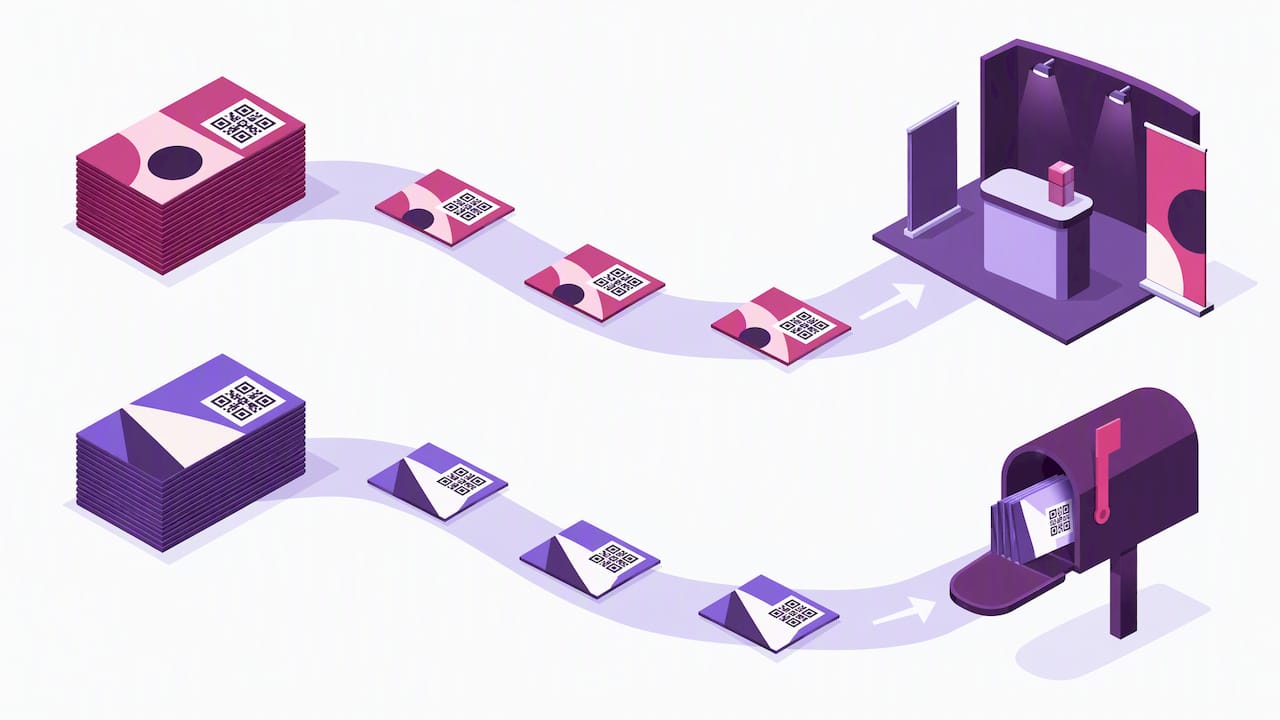
QR codes are the obvious starting point: nearly every printed piece now carries one linking to a landing page, a video, or a contact form. What’s changed is sophistication, with variable QR codes that route different print runs to different tracking URLs, so a trade show stack and a direct mail stack get measured separately.
Augmented reality overlays are showing up on higher-end collateral: scan a business card or brochure cover and a short video or 3D product demo appears on the viewer’s phone. It’s still a niche add for most startups given production complexity, but it signals where premium print collateral is heading.
Variable-data printing has also matured well beyond “Dear [First Name].” Postcards and sell sheets can now pull in different images, offers, or case studies based on the recipient’s industry or role, all from one print run. Combined with Adobe Express’s integrated design-to-print workflow, which lets teams build and order common pieces like postcards and business cards from templates, the barrier to running a personalized print campaign has dropped substantially for small teams without in-house production staff.
Measuring Print’s Role Alongside Digital Tracking
Print earns its budget when you can measure it. Unique QR codes, campaign-specific URLs, and dedicated landing pages turn a printed piece into a trackable channel, not a guess. Print tends to outperform digital at trade shows, local outreach, and high-touch sales conversations, where a physical handoff builds trust faster than a link ever could.
— Coumba Evelyn
How Coumba Win Helps You Design and Deliver Print Collateral Fast
We build print-ready design the same way we build everything else: fast, founder-collaborative, and allergic to generic templates. Whether you need a pitch folder before a fundraising round or a full set of print collateral including branded swag and booth materials, we work directly with you to get it production-ready without the back-and-forth of a typical agency process.
| Service | What it covers |
|---|---|
| Print Design | Business cards, brochures, sell sheets, direct mail |
| Pitch Deck Design | Investor-ready printed and digital decks |
| Graphic Design | Event kits, signage, branded swag |
If you want a partner who treats print collateral as part of a bigger growth story rather than a last-minute checklist item, see what we offer and start a conversation about your next launch or event.
FAQ
What does “print collateral” mean?
Print collateral refers to physical, branded materials like brochures, business cards, and flyers that a business uses to promote itself, support sales conversations, or build recognition offline. It’s the printed counterpart to digital marketing assets.
What are some examples of print collateral?
Common examples include business cards, brochures, flyers, direct mail postcards, pull-up banners, and branded swag like notebooks or tote bags. Teams typically mix a few of these into a kit depending on the event or sales scenario.
What is print collateral design?
Print collateral design is the process of creating these physical materials with attention to brand consistency, legibility, and production specs like bleed, color mode, and paper stock. It differs from digital design because printed pieces can’t be edited after the run is complete, so the file prep stage matters far more.
Is print a declining industry?
Print has shrunk in some traditional categories, but it hasn’t disappeared, particularly for branded business materials, direct mail, and event collateral where a physical object still builds trust that a screen struggles to replicate. Many teams now treat print as one channel among several rather than the primary one.
Sources
A few references worth bookmarking if you’re implementing any of this directly: