Build a Minimum Viable Brand in 4 Weeks, a Founder Playbook

Build a Minimum Viable Brand in 4 Weeks, a Founder Playbook
A minimum viable brand (MVB) is the smallest set of brand assets, name, value proposition, logo, palette, and core message, that lets you launch credibly and start learning from real customers. Use it when you’re pre-revenue, testing a new market, or need to move in weeks, not months. Skip it in favor of a full brand build only when you’re already scaling, raising a big round, or walking into enterprise sales meetings where polish signals trust.
Coumba Win Design
Shape a Brand Built to Grow
Coumba Win creates bold, strategic branding and digital experiences tailored to the growth challenges faced by startups.
Table of Contents
What Is a Minimum Viable Brand, Exactly?
Founders hear “minimum viable brand” and picture a rushed logo slapped on a landing page. That’s not it. An MVB is a strategic foundation, thin by design, built to be tested and revised rather than treated as gospel. Denise Lee Yohn, who coined the framework, describes it as enough structure to launch and learn, not a finished brand bible with 40 pages of guidelines nobody will read.
The trick is knowing what stays fixed and what stays flexible. Your product features, pricing, even your target customer segment can shift hard during your first year. Your brand core, the promise you’re making and why you exist, should not. Yohn’s guidance is blunt on this point: keep the brand core stable while the product pivots underneath it. An MVB is intentionally thin and testable, which means every asset you produce should be built to be questioned, measured, and swapped if it doesn’t work. That’s the whole point.
Why a Lean Brand Beats a Polished One (Most of the Time)
Speed is the obvious win. A lean brand gets you to market in weeks, and every week you’re not launched is a week you’re guessing instead of learning. Full brand development, workshops, competitive audits, twelve rounds of logo revisions, can burn six figures and six months before you’ve sold a single unit. An MVB skips that sunk cost entirely.
The bigger benefit is what happens after launch. A minimal brand paired with real customer contact gives you validated learning instead of internal opinions about what your messaging should say. You find out fast if your value proposition lands or falls flat.
That said, an MVB isn’t universal. If you’re closing a major enterprise contract, running a splashy funding announcement, or facing heavy press coverage, a thin brand can undercut credibility right when you need the opposite.
The Core MVB Elements You Actually Need First
Cut everything that isn’t on this list. Seriously.
None of this needs custom illustration or a typeface foundry. Shopify’s rundown on minimum viable brands points to the same conclusion: simple tools, whether that’s Canva for quick assets or Webflow for the site itself, get you a usable identity without the agency-scale price tag. Save the custom design work for after you’ve proven the concept has legs.
How to Build and Test Your MVB in Under a Month
Run this in sequence. Don’t skip steps to save time, since skipping is exactly how founders end up rebuilding everything three months later.
Where Founders Get an MVB Wrong
The most common mistake is confusing a positioning statement with a feature list. “We help X do Y so they can Z” is positioning. A bullet list of thirteen product capabilities is not, and customers tune it out fast.
Overdesign is the second trap, spending three weeks perfecting a logo nobody has seen next to your actual offer yet. And locking assets in too early, before any real customer feedback, wastes the entire point of building lean. If your team starts saying “we can’t change that, it’s already on the merch,” you’ve moved too fast.
Pro Tip: Test your messaging line on ten strangers before you touch the logo. If seven of them can’t repeat back what you do, the problem isn’t your design, it’s your words.
A second one worth stealing from agency practice: keep a swipe file of every version of your value proposition you’ve tested, even the bad ones. Patterns show up fast once you can see them side by side.
When You’re Ready to Grow Beyond an MVB
Three signals mean it’s time to invest further: conversions that repeat reliably rather than one-off wins, growth that’s straining your current assets (a logo file too small for a trade show banner, a palette that clashes on new packaging), or a partner or investor asking for something that looks less improvised.
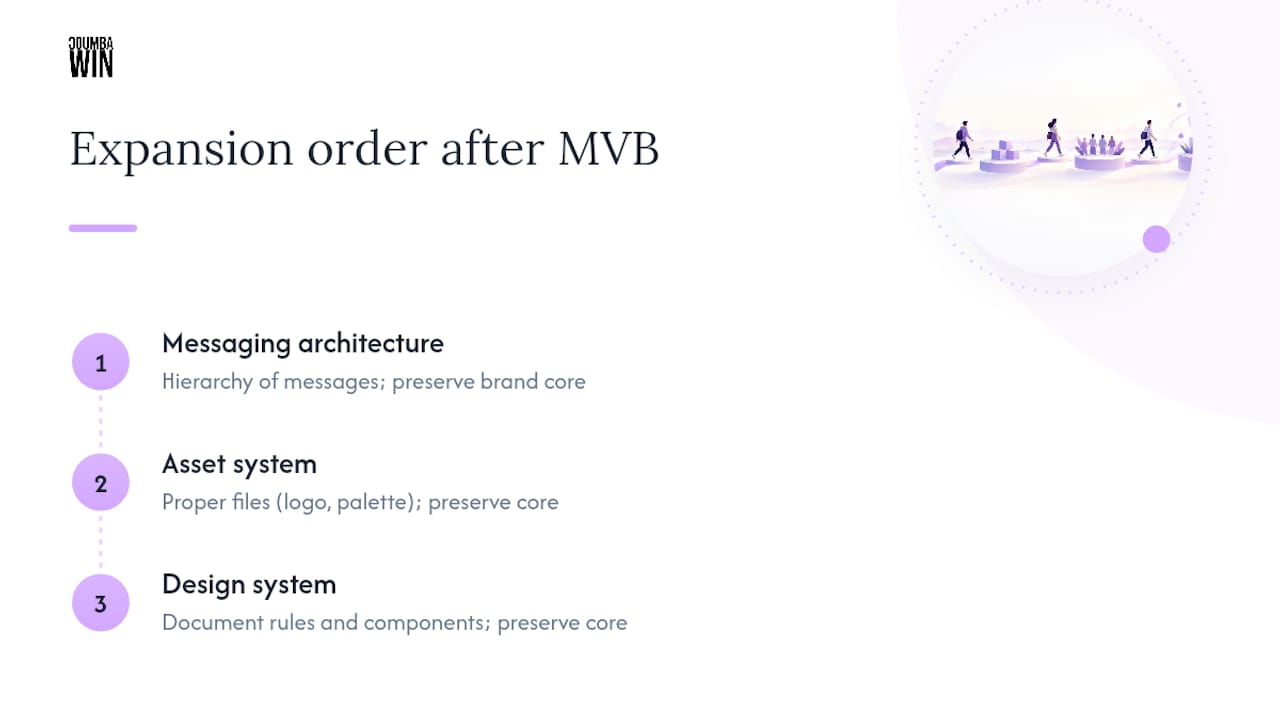
When that happens, expand in order: messaging architecture first, then a proper asset system, then a full design system with documented rules. Keep your original brand core intact through the process. Communicate any visual changes to existing customers before you flip the switch, and set clear migration rules internally so nobody’s using the old logo six months after launch. Continuity matters more than a fresh coat of paint.
What Practitioner Experience Tells Us About Speed vs. Strategy
A design partner that works with founders who need to move fast without treating branding as an afterthought. Across pitch decks, Demo Day kits, and early web builds, the pattern holds: startups that nail a tight, testable brand core before scaling assets consistently avoid expensive rework later. One reusable pattern worth borrowing, lock your core promise before you touch visual polish, and let feedback guide everything after that.
The Advice Nobody Gives You About Building Lean
Most branding advice for startups treats speed and strategy as opposing forces. Pick one, the thinking goes, fast and scrappy or slow and thoughtful. That framing is wrong, and it’s cost founders real money.
The MVB model works precisely because it refuses that trade off. You can move in weeks and still be strategic, provided you’re disciplined about what “strategic” actually means at this stage. It doesn’t mean a 40-page brand book. It means knowing your one customer, your one promise, and refusing to touch either until real feedback tells you otherwise.
Where conventional advice falls short is in treating logo design as the starting point. It isn’t. Positioning is. A gorgeous logo attached to a confused value proposition converts nobody, while a plain wordmark attached to a sharp, specific promise converts plenty. If you take one thing from this: sequence your MVB the way you’d sequence an MVP. Define the hypothesis first. Build the smallest thing that tests it. Only then decide what deserves more investment.
Ready to Turn Your MVB Into a Full Brand?
Once your minimum viable brand starts converting, the smartest move is investing in the pieces built to scale with you, not starting from scratch with a generic template. Design partners work directly with founders who’ve validated their message and are ready for support that treats design as a growth lever, not decoration.
That means custom web design and development, UI and UX work, and a documented style guide that turns your tested MVB into repeatable rules your whole team can use. If your landing page experiment proved the concept, a Webflow build gets you a real site fast without the six month agency timeline. DIY your MVB while you’re validating; bring in a partner once you’re expanding it into something that has to hold up under scale, investor scrutiny, or a bigger customer base. Reach out through Coumbawin to talk through where your brand stands and what expansion actually looks like for your stage.
Sources
For deeper detail, see Denise Lee Yohn’s original MVB framework and development guide, Shopify’s practical breakdown, and VentureBeat’s explainer on MVP testing patterns. For a deeper asset checklist, Coumba Win Design’s brand identity checklist for startups walks through execution in more detail.
FAQ
What Is the 3-7-27 Rule in Branding?
It’s a rule of thumb suggesting people typically need multiple consistent exposures, often cited around 3, 7, and 27 touchpoints, before a brand becomes familiar and memorable. For an MVB, it means picking one channel and repeating your message consistently rather than spreading thin across five.
What Does “Minimum Viable Company” Mean?
It’s a related idea describing the smallest operational setup, product, brand, and basic processes, needed to test whether a business idea works in the real market. An MVB is typically one piece of that larger minimum viable company approach.
What Is an Example of a Minimum Viable Product?
A classic example is a landing page describing a product that doesn’t exist yet, used to gauge signup interest before any code gets written. This lean testing pattern works for validating both product demand and brand messaging at once.
How Do I Develop an MVP?
Start by defining the single problem you’re solving and the smallest version of a solution that tests it, then get that version in front of real users fast. The goal, according to MVP methodology, is gathering validated learning quickly, not building something polished on the first try.
Does Coumba Win Design Help With MVB Assets?
Yes, Coumba Win Design offers services covering the exact assets an MVB checklist calls for, including logo and visual identity work, messaging support, and rapid Webflow builds for landing page tests. Current project details and pricing are available directly on Coumba Win Design’s site.