Restore Trust with a 6 Step Brand Messaging Framework for Founders
Restore Trust with a 6 Step Brand Messaging Framework for Founders
A brand messaging framework is the structured system, positioning at the top, pillars and proof points underneath, that keeps every piece of content sounding like the same company said it. It matters more than ever because trust is getting scarce: when AI content floods every channel, the brands with a tight, human-verified message are the ones people actually believe.
TL;DR:
- A brand messaging framework organizes core positioning, value pillars, proof points, voice, tone, and channel modifiers to ensure consistent and trustworthy communication.
- In a market where trust is waning due to AI-saturated content, a documented framework helps maintain credibility through human expertise and verified signals.
- Building a framework involves steps like gathering insights, drafting positioning statements, defining pillars and proof points, and continuously testing and updating it.
- Embedding the framework across teams using playbooks, CMS snippets, and scheduled audits prevents messaging drift and improves content efficiency.
- Prioritize human oversight on AI-generated content, especially for customer-facing materials and claims, to preserve trust and brand integrity.
Table of Contents
- What is a brand messaging framework, exactly?
- Why a formal messaging framework matters right now
- The core components every framework needs
- A practical 6-step process to build your framework
- How to embed the framework across teams and tools
- Keeping trust intact as AI scales your content
- Templates you can copy today
- Why this matters to us at Coumba Win
- Let’s build a framework that actually gets used
- Sources
- FAQ
What is a brand messaging framework, exactly?
Think of it like a family tree for your words. At the top sits your core positioning statement, the one true sentence about who you are and why you matter. Below that, you’ve got three to five value pillars (the big themes you keep coming back to). Under each pillar live proof points, the receipts, basically, that back up your claims. And at the bottom, channel modifiers adjust tone and length so the same message works on a billboard, in an email subject line, or in a 15-second video script.
Here’s why the hierarchy matters, not just as an org chart exercise: without it, messaging drifts. Someone on the sales team writes “we’re the fast, affordable option,” marketing says “we’re premium and thoughtful,” and six months later nobody can tell what the brand actually stands for. A hierarchy forces every new piece of content to trace back to one source of truth.
Quick example of each layer in action:
- Positioning: “We help startups launch faster with design that founders can actually understand.”
- Pillar: “Speed without sacrificing craft.”
- Proof point: A specific turnaround time or process detail that backs the speed claim.
- Channel modifier: That same idea becomes a punchy homepage headline, a warmer paragraph in a welcome email, and a single confident line in a pitch deck.
Gartner’s own message house tool is built around this exact logic: one structure, many outputs, zero fragmentation.
Why a formal messaging framework matters right now
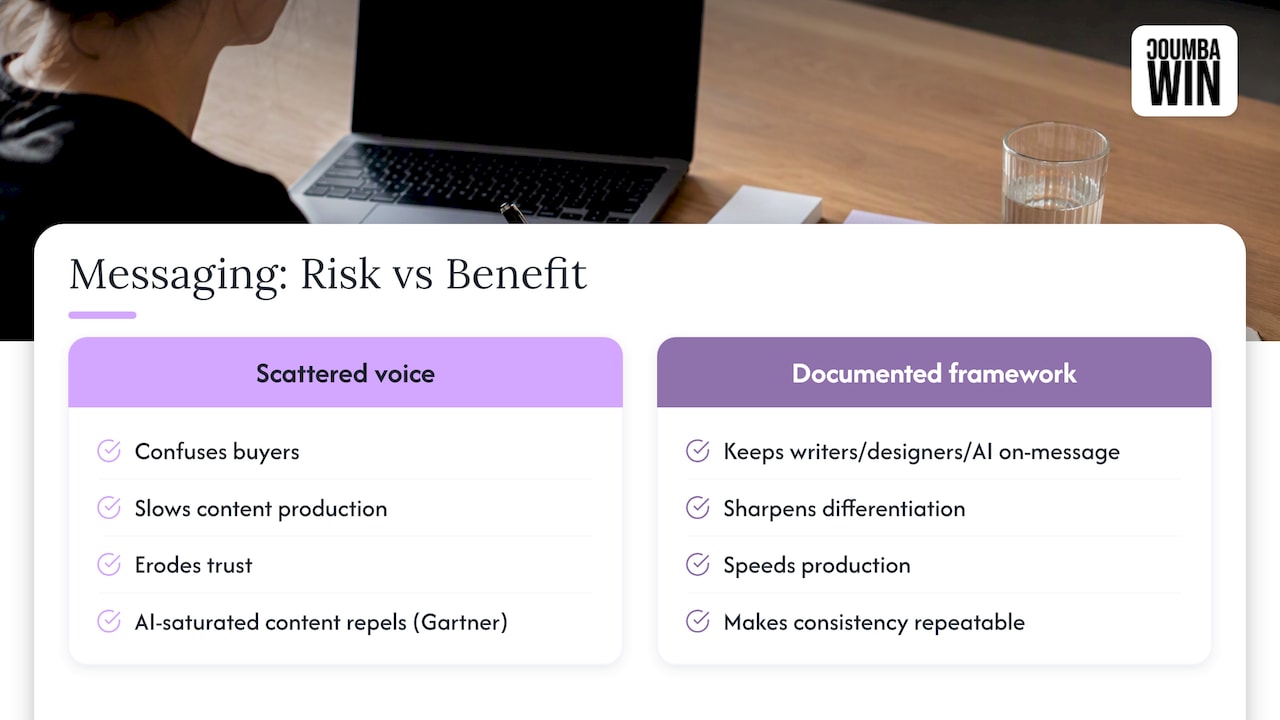
Consistency isn’t a nice-to-have anymore, it’s risk management. A scattered brand voice confuses buyers, slows down content production (because every writer reinvents the wheel), and, worst of all, erodes trust at the exact moment trust is hardest to earn back.
Consumers are already pulling back from AI-saturated content. Gartner’s survey found that a significant share of consumers rely less on influencers because of AI, a signal that overproduced, indistinguishable content is actively pushing people away rather than pulling them in.
That’s the risk side. The upside is that a documented framework does three things well: it keeps every writer, designer, and AI tool producing on-message content, it sharpens differentiation because your pillars are yours (not generic industry-speak), and it speeds up production since nobody’s starting from a blank page. Gartner’s research on trust scarcity argues that human expertise and consistent delivery are becoming the actual differentiators in a market where content itself is cheap to produce. A framework is how you make consistency repeatable instead of accidental.
The core components every framework needs
Before you write a single word of finished copy, you need five building blocks locked down. Skip any of these and the rest of the framework wobbles.
- Positioning statement: one sentence using the formula “For [audience], [brand] is the [category] that [key differentiator], because [proof].” Example: “For early-stage founders, a design partner treats branding as a growth lever, because every project starts with the founder’s actual business problem, not a template.”
- Value pillars (3 to 5): the recurring themes that support your positioning. Each pillar needs at least one defensible proof point, a stat, a process detail, a specific outcome, not a vague adjective.
- Voice and tone: voice is constant (are you playful, direct, formal?), tone shifts by context (a launch announcement reads differently than a support email).
- Channel modifiers: short rules for how voice and tone bend across web copy, social captions, sales decks, and email.
- Audience segments: who you’re talking to in each context, because “everyone” is not a segment.
Pro Tip: Write your positioning statement, then delete every adjective. If it still makes sense and still sounds like you, the sentence is doing real work.
Differentiation matters here more than polish. AMA’s research on the 5Bs framework found that brands with unique, defensible messaging outperform those that copy category conventions, so resist the urge to sound like everyone else in your space.
A practical 6-step process to build your framework
Building a framework isn’t a brainstorm, it’s a sequence. Skip steps and you end up with a nice-looking document nobody actually uses.
- Gather insights. Talk to customers, audit competitor messaging, and identify category truths (the things every buyer already believes about your industry, whether you say them or not).
- Draft positioning. Use the formula above, write five versions, and pressure-test each against the question “could a competitor say this too?” If yes, keep refining.
- Define pillars and proof points. Pick three to five pillars that support the positioning, then attach a real, checkable proof point to each one. No proof point, no pillar.
- Craft voice, tone, and channel rules. Write a short voice guide (adjectives plus do’s and don’ts), then map tone shifts across your main channels.
- Build templates and message-house artifacts. Turn the framework into a one-page message house, plus copy-paste snippets for common formats: headlines, email openers, social bios.
- Test, measure, and iterate. Ship the messaging, watch how it performs (engagement, conversion, sentiment), and revisit the framework on a set schedule rather than waiting for it to feel broken.
That last step is where most teams drop the ball. A framework built once and never revisited becomes stale the moment your market shifts or a competitor repositions. Treat it like a living document with a review date, not a plaque on the wall. Startups building their identity from the ground up often benefit from pairing this process with a founder’s guide to brand identity, since positioning and visual identity tend to move together.
How to embed the framework across teams and tools
A framework that lives in a slide deck nobody opens is worse than no framework at all. Operationalizing it means turning strategy into habits.
- Playbooks and briefs: every content brief should reference the relevant pillar and proof point, not just a topic.
- CMS snippets: store approved headline and tagline variations directly in your content system so writers grab language instead of reinventing it.
- Role assignments: name one person (usually brand or marketing lead) who owns the framework and signs off on major messaging changes.
- Governance cadence: schedule a consistency audit every quarter, checking website copy, sales decks, and social channels against the message house.
Pro Tip: Give every new hire a one-page cheat sheet with the positioning statement, pillars, and three approved headline examples. It saves more onboarding time than any deck ever will.
Measurement matters too. Track message resonance (which pillars get quoted back to you by customers), run periodic consistency audits across channels, and watch for brand-lift signals in surveys or search behavior. None of this needs to be complicated, but it does need to be scheduled, because “we’ll check on it eventually” is how drift creeps back in.
Keeping trust intact as AI scales your content
Here’s the tension every marketing team is living with right now: AI makes it cheap to produce ten times more content, but Gartner’s trust-scarcity research shows that volume without credibility signals actively damages trust rather than building it.
The fix isn’t to avoid AI, it’s to design trust signals into the process. That means expert proof (named sources, real data, not vague claims), visible human authorship on anything opinion-driven, and verified-creator signals where relevant. Set human-in-the-loop gates: AI drafts, a human with framework knowledge reviews before publish. Track provenance so you know which pieces were AI-assisted and can apply extra scrutiny there.
Brands must design for trust: human expertise and consistent delivery are becoming the primary drivers of discoverability and differentiation. Gartner, on the AI-era trust shift
Prioritize human touchpoints where credibility matters most, positioning statements, customer-facing FAQs, anything making a claim, and let AI handle the lower-stakes repetitive formatting work instead.
Templates you can copy today
A message house is the simplest way to see your whole framework on one page.
| Layer | Example content |
|---|---|
| Positioning | For early-stage founders, [Brand] is the partner that turns design into a growth advantage |
| Pillar 1 | Speed without sacrificing craft |
| Pillar 2 | Collaboration over templates |
| Pillar 3 | Outcomes you can measure |
| Proof point | Specific process detail or turnaround commitment |
| Channel modifier (homepage) | Short, confident headline built on Pillar 1 |
| Channel modifier (email) | Warmer, second-person framing of the same pillar |
| Channel modifier (social) | One-line hook with a question or bold claim |
Two positioning templates worth testing:
- Formula A: “For [audience], [brand] is the [category] that [differentiator], because [proof].”
- Formula B: “[Brand] helps [audience] [outcome] by [unique method], unlike [generic alternative].”
And three short-copy adaptations of a single pillar (“collaboration over templates”): a homepage headline might read “Design that starts with your problem, not our portfolio.” An email opener could say “We don’t hand you a template and disappear.” A social caption might just ask, “Ever gotten a ‘custom’ design that looked exactly like everyone else’s?” Same pillar, three completely different deliveries, which is the whole point of channel modifiers. For more on adapting message modifiers specifically for web copy, see this piece on aligning website design with brand values.
Why this matters to us at Coumba Win
I’ve watched enough startups build gorgeous brand decks that nobody on the founding team could actually recite back. That’s the real failure mode: not bad taste, but a framework too complicated to live in anyone’s head. The ones that work are the ones a founder can say out loud, unprompted, in a pitch meeting.
At Coumba Win, messaging and design get built together rather than handed off in sequence, because a positioning statement that doesn’t match the visual identity confuses buyers just as much as inconsistent copy does. Our engagements with founders treat the message house as a working document from day one, not a deliverable that gets filed away after launch.
The teams that get this right treat differentiation as a discipline, not a slogan.
— Coumba Evelyn
Let’s build a framework that actually gets used
Most agencies hand you a brand book and a positioning statement in a PDF, then leave you to figure out how it applies to your website, your pitch deck, and your next hundred pieces of content. That gap between strategy and execution is where most startup messaging quietly falls apart.
Coumba Win closes that gap by building the framework and the deliverables together: web design and development, UI and UX work, pitch decks, and print materials all pulling from the same positioning and pillars from the start. Founders who treat design as a growth lever, rather than a final coat of paint, can get a consistent voice across every touchpoint without reinventing the framework each time a new asset comes up. You can see how this plays out across real engagements in our portfolio of work, including projects for educational platforms and apparel brands that needed both a sharper narrative and the visual system to carry it.
If your messaging feels like it was written by three different people (because it probably was), get in touch and let’s build something founders can actually say out loud.
Sources
Two Gartner pieces anchor the AI-trust argument here: the September 2026 survey on declining trust in AI-heavy content, and the trust-scarcity analysis on why human expertise now drives discoverability. AMA’s 5Bs framework research backs the differentiation argument, and Gartner’s message house tool is worth downloading directly if you want a working template. For AI-specific brand accuracy concerns, this guide on correcting AI-generated business summaries is a useful companion read.
- A new branding framework: the 5Bs (AMA)
- Tool: Use This Message House to Direct Your People and AI (Gartner)
FAQ
What are the three C’s of brand messaging?
Definitions vary across sources, but a common version refers to clarity, consistency, and credibility: your message needs to be easy to understand, delivered the same way everywhere, and backed by real proof. Some practitioners swap in “consistency, differentiation, and relevance” instead, so treat the exact wording as less important than making sure your framework covers all three ideas.
How is a messaging framework different from a brand style guide?
A messaging framework governs what you say (positioning, pillars, proof points, tone), while a style guide typically governs visual identity like logos, color, and typography. The strongest brands build both together so the words and the visuals reinforce the same positioning rather than working against each other.
How often should we update our messaging framework?
Most teams review their framework on a quarterly or annual cadence, checking it against market shifts, new competitors, or product changes rather than waiting until messaging feels obviously broken. A scheduled audit, not a reactive one, is what keeps the framework from drifting out of date.
Can AI tools help write brand messaging without hurting consistency?
AI can speed up drafting once your positioning, pillars, and voice rules are documented, since it gives the tool a source of truth to work from. The risk comes from skipping human review entirely, which is why Gartner recommends building human-in-the-loop checkpoints for anything customer-facing.