Why Interactive Web Design Converts: 2026 Guide

Why Interactive Web Design Converts: 2026 Guide
Interactive web design converts because it transforms passive visitors into active participants who engage, explore, and ultimately buy. The industry term for this approach is “interaction design,” and it covers everything from product configurators and quizzes to real-time form validation and scroll-driven storytelling. Static pages ask visitors to read and trust. Interactive pages let visitors discover and decide. That difference is not cosmetic. It shows up directly in your conversion rates, your lead quality, and your bottom line.
Why interactive web design converts better than static
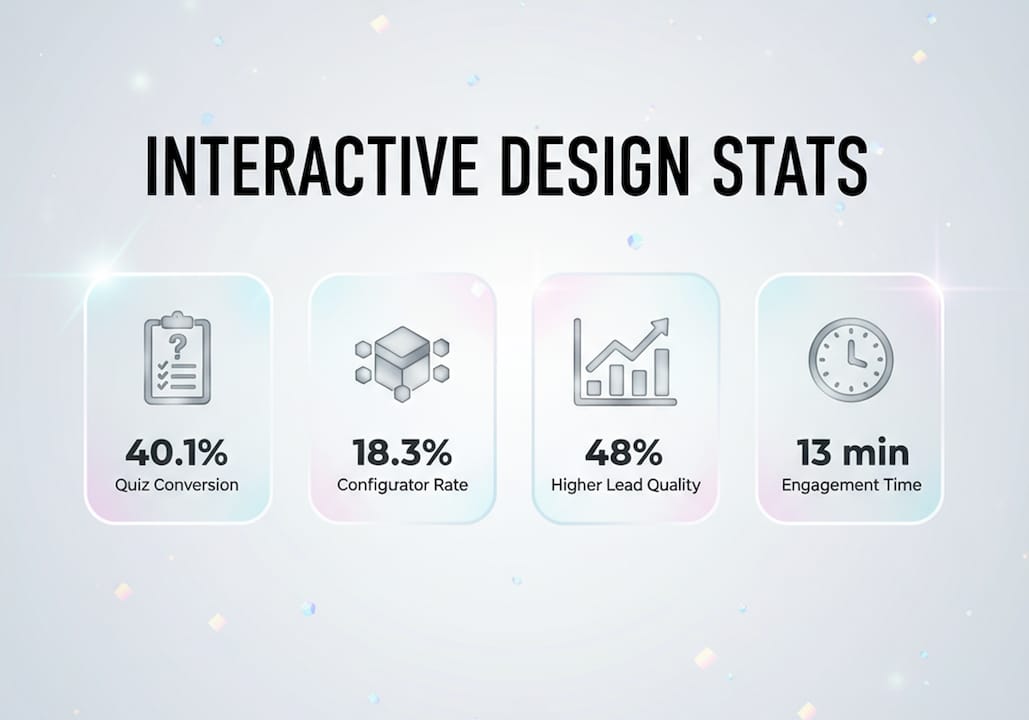
The numbers here are genuinely hard to argue with. Interactive content drives 2.4x more conversions than static equivalents. Quizzes alone average a 40.1% lead generation conversion rate. Product configurators hit an 18.3% conversion rate compared to 7.6% for static product pages. Interactive demos push B2B conversion rates up by 32–45%. Every one of those numbers points to the same conclusion: when users do something on your site, they convert at a dramatically higher rate than when they just read.
Engagement depth tells the same story. Visitors spend 13 minutes on interactive content versus 8.5 minutes on static pages. Session durations increase 200–400% with interactive strategies, and interactive content earns 4–5 times more page views than static content. Longer sessions mean stronger SEO signals and more time for your value proposition to land.

Lead quality improves too, not just lead volume. Interactive tools produce Sales Qualified Leads at a 48% higher rate than static PDF leads. That happens because interactive content collects behavioral data. You learn what options a user configured, which quiz answers they chose, and where they hesitated. Your sales team gets context, not just a name and email.
| Metric | Interactive design | Static design |
|---|---|---|
| Average conversion rate (configurators) | 18.3% | 7.6% |
| Lead generation conversion (quizzes) | 40.1% | Much lower |
| Demo conversion lift | 32–45% | Baseline |
| Average session duration | 13 minutes | 8.5 minutes |
| SQL conversion rate lift | +48% | Baseline |
What psychology explains about interactivity and conversion
The brain is wired for the input-output loop. You do something, you get a result, you feel satisfied. Interactive content closes the curiosity gap by delivering immediate, personalized results. Static content creates anticipation without closure. That unresolved tension is not engaging. It is just frustrating, and frustrated visitors leave.
The reward loop works like this: a user answers a quiz question, sees a personalized recommendation, and feels understood. That feeling of being understood is trust. Trust is what converts. Static content cannot manufacture that feeling because it delivers the same message to everyone, regardless of who is reading.
Self-education is the other big psychological lever. Interactive demos let buyers self-educate, reducing buyer resistance compared to traditional sales demos. When users reach their own conclusions through guided exploration, they own those conclusions. They are not being sold to. They are deciding. That shift from “being sold to” to “deciding” removes the single biggest friction point in any conversion funnel.
“Interactive design replaces selling with self-education, allowing users to explore and trust their own conclusions.” This is not a design philosophy. It is a conversion strategy.
Pro Tip: Place your conversion ask (form, CTA, or sign-up) directly on the results page of a quiz or configurator. Moving the ask to the moment of peak engagement, right after a user sees their personalized result, removes the follow-up wait time and lifts conversion rates significantly.
What interactive web design techniques actually drive conversions?
Not all interactivity is equal. Some elements move the needle. Others just look cool and slow your site down. Here is what the data says actually works.
Micro-interactions and real-time form validation
Micro-interactions on buttons and forms reduce perceived effort by 20–40%. A button that responds visually when clicked, a field that confirms correct input in green, a progress bar that shows how far along a user is: these tiny signals tell the user the system is working and they are on the right track. Real-time form validation reduces form abandonment by 10–20 percentage points. Tools like React Hook Form and Formik make this cheap to implement relative to the conversion gains.
Product configurators
Well-designed configurators lift conversion 15–40%. The catch is choice paralysis. Too many options and users freeze. Best practice caps configurator options at 3–5 choices per step and pre-selects sensible defaults. Think of it like a good restaurant menu: curated beats comprehensive every time.
Quizzes and assessments
Quizzes are the highest-converting interactive format for lead generation, averaging 40.1% conversion. They work because they feel like a service, not a pitch. A skincare brand asking “What is your skin type?” is not collecting data. It is offering a recommendation. The user gets value. You get a qualified lead with behavioral context attached.
Gamified onboarding flows
Gamified onboarding raises SaaS activation rates 15–35%. Progress bars, checklists, and milestone rewards turn a dry setup process into something that feels like progress. Duolingo built an entire product strategy around this principle. For SaaS founders, this is one of the highest-ROI places to invest in interaction design.
Scroll-driven storytelling and AI-powered chat
Scroll-driven storytelling reveals content progressively as users move down the page. It controls pacing and keeps users engaged longer than a wall of text. AI-powered chat functions as a contextual assistant, answering specific questions at the exact moment a user has them. Neither replaces good copy, but both reduce the friction between curiosity and conversion.
| Interactive element | Primary benefit | Typical conversion impact |
|---|---|---|
| Product configurator | Personalized purchase path | +15–40% conversion lift |
| Quiz or assessment | Lead generation with context | 40.1% avg lead conversion |
| Real-time form validation | Reduced abandonment | 10–20 point drop in abandonment |
| Gamified onboarding | SaaS activation | +15–35% activation rate |
| Interactive demo | B2B self-education | +32–45% conversion lift |
Pro Tip: Prioritize interactivity that aligns with a clear user goal. Every interactive element should help a user complete a task or reduce uncertainty. If it does neither, it is decoration, and decoration costs you page speed and conversions.
How does interactive design compare to static design for conversions?
Static design is not bad. It is just limited. A well-written static page can inform. It cannot adapt. It delivers the same experience to a first-time visitor and a returning buyer, to someone ready to purchase and someone still researching. That one-size-fits-all approach is where conversions leak.
Interactive design provides immediate, personalized feedback. It meets users where they are in the decision process. A visitor who configures a product and sees a live price update has far more purchase confidence than one who reads a spec sheet. The experience itself builds certainty, and certainty converts.
The performance trade-off is real, though. Heavy animations that break performance budgets hurt conversions. A slow site with flashy interactions performs worse than a fast static site. The rule is simple: every interactive element must earn its place by serving a user goal. If it does not, it harms more than it helps.
Measuring the right things matters here too. Time-on-page is a weak proxy for engagement. Use click-level attribution and heatmap tools like Hotjar or Microsoft Clarity to understand which interactive elements users actually engage with. That data tells you where to invest and where to cut.
Pro Tip: Audit your interactive elements with a performance tool like Google Lighthouse before launch. A Lighthouse performance score below 80 on mobile will cost you more in lost conversions than any interactive feature will gain.
For a deeper look at conversion optimization strategies that complement interaction design, the principles around friction reduction and user intent alignment apply directly to how you build and test interactive experiences.
Key Takeaways
Interactive web design converts because it replaces passive reading with active exploration, delivering personalized feedback that builds trust, reduces friction, and drives users toward confident purchase decisions.
| Point | Details |
|---|---|
| Interactivity drives measurable lift | Configurators convert at 18.3% vs 7.6% for static pages; quizzes average 40.1% lead conversion. |
| Psychology powers the effect | The input-output reward loop and self-education effect reduce buyer resistance and build trust. |
| Technique selection matters | Micro-interactions, real-time validation, and gamified onboarding deliver the highest ROI per element. |
| Performance is non-negotiable | Heavy animations that slow load times cancel out conversion gains from interactivity. |
| Measure with precision | Use heatmaps and click-level attribution, not just time-on-page, to evaluate what actually converts. |
My honest take on where interactive design actually pays off
I have seen a lot of founders get excited about interactivity for the wrong reasons. They want the cool scroll animation. They want the 3D product spin. And look, I get it. That stuff is genuinely fun to build (and I will not pretend I do not love a good scroll-driven reveal). But when we are talking about conversion, the flashy stuff is almost never where the money is.
The highest ROI interactive elements I have seen, again and again, are the boring-sounding ones. Real-time form validation. A well-structured product configurator with five options and a smart default. A quiz that ends with a genuinely useful recommendation. These are not glamorous. They are just effective.
What I keep coming back to is this: interactivity works when it reduces uncertainty. Your visitor has a question. Your interactive element answers it immediately and personally. That is the whole game. Everything else is decoration.
The mistake I see most often is adding interactivity as a layer on top of a confusing value proposition. A beautiful configurator cannot save a product page that does not clearly explain what the product does. Get the clarity right first. Then add the interaction design that helps users feel that clarity, not just read it.
If I were advising a startup founder right now, I would say: start with a quiz or an interactive demo. Both are relatively fast to build, both collect behavioral data you will actually use, and both have the strongest conversion data behind them. Test one, measure it properly with heatmaps and click attribution, and then decide what to build next.
— Coumba Evelyn
Build interactive experiences that convert with Coumba Win Design
Knowing why interactivity converts is one thing. Building it well is another. Coumba Win Design works with startup founders who want design that actually moves the needle, not just looks good in a Figma file. The style guide and UI components give you a ready-to-use foundation for building interactive elements like configurators, onboarding flows, and real-time forms without starting from scratch. If you are heading into a product launch or investor demo, the Demo Day Kit packages everything you need to ship a polished, high-converting interactive experience in 14 days. Bold design, real outcomes, and no wasted sprints.
FAQ
What makes interactive web design convert better than static?
Interactive design converts better because it delivers immediate, personalized feedback that builds user confidence and reduces friction. Static design delivers the same experience to every visitor regardless of where they are in the decision process.
Which interactive elements have the highest conversion impact?
Product configurators, quizzes, and interactive demos consistently show the strongest conversion data. Configurators convert at 18.3% versus 7.6% for static pages, and quizzes average 40.1% lead generation conversion.
Does interactivity hurt site performance and SEO?
Heavy animations that exceed performance budgets do hurt conversions and SEO. Every interactive element should serve a clear user goal and pass a performance audit with tools like Google Lighthouse before launch.
How do I measure whether my interactive design is working?
Use click-level attribution and heatmap tools like Hotjar or Microsoft Clarity rather than relying on time-on-page alone. These tools show which interactive elements users actually engage with and where drop-off occurs.
What is the fastest interactive element to implement for conversion gains?
Real-time form validation using tools like React Hook Form or Formik is one of the cheapest and fastest wins. It reduces form abandonment by 10–20 percentage points with relatively low development effort.
Recommended