5 Days to a Tested Prototype for Startups: Founder First Design Sprint
5 Days to a Tested Prototype for Startups: Founder First Design Sprint
A five-day design sprint gives your startup a realistic prototype and validated user feedback in one focused week. It works for founders and small cross-functional teams trying to decide fast, before they’ve burned months and a chunk of runway on a guess. Success looks like one thing: a tested hypothesis and a clear go, pivot, or refine decision waiting on the other side of Friday.
TL;DR:
- A well-prepared, specific Sprint Question is critical; vague aims like “improve onboarding” lead to untestable results and wasted effort.
- A Decider must be designated before recruitment to ensure clear authority, preventing sprints from producing material but no decision.
- Conducting five user tests, each about 45 to 60 minutes, typically reveals 85% of usability issues, making this the optimal sample size for startups.
- Teams should prioritize keeping the prototype deliberately rough and focused on the key tested moment, avoiding unnecessary polish or backend features.
- Half-attended sprints or unclear goals can derail progress; working with an experienced facilitator and strict scheduling improves outcomes significantly.
Table of Contents
- What Is a Design Sprint for Startups?
- Day-by-Day Design Sprint Agenda: What to Build Each Day
- How Do You Prepare for a Startup Design Sprint?
- How to Prototype Fast Without Overbuilding
- How Do You Run and Read a Sprint’s Test Day?
- What Mistakes Ruin a Startup’s Design Sprint?
- Why Facilitation Experience Changes Sprint Quality
- Design Sprint for Startups: Run a 5-Day Prototype and Test
- Need Help Running Your Startup’s Design Sprint?
- Sources
- FAQ
What Is a Design Sprint for Startups?
A design sprint is a structured, five-day process that takes a fuzzy startup problem and forces it into a testable prototype by Friday afternoon. GV’s Design Sprint methodology frames it as a shortcut. Instead of months of internal debate, you compress the whole argument into one week and let real users settle it.
The five phases break down like this:
- Map (Monday): define the problem and pick a target
- Sketch (Tuesday): generate individual solutions, quietly
- Decide (Wednesday): pick the strongest concept and storyboard it
- Prototype (Thursday): build a believable facade, not a product
- Test (Friday): watch five real users react to it
A sprint isn’t the right tool for every problem. If your team already agrees on the solution and just needs to build it, skip the theater and ship. Sprints earn their keep when there’s real disagreement, a big unknown, or a decision expensive enough that guessing wrong would hurt. Budget at least one planning day before the sprint even starts, and protect all five days on the calendar. Half-measures produce half-results.
Day-by-Day Design Sprint Agenda: What to Build Each Day
Here’s the actual week, hour by hour in spirit if not in minutes. This is the checklist version, not the theory version.
- Monday: map and target. The team maps the problem end to end, interviews internal experts for context, and picks a specific target moment to solve. This is also when you name your Decider (more on that below) and lock in the Sprint Question you’re trying to answer.
- Tuesday: lightning demos and Crazy 8s. Everyone looks at existing solutions (inside and outside your industry) for a burst of lightning demos, then goes quiet. Crazy 8s (eight rough sketches in eight minutes) forces fast divergent thinking. Each person finishes with one detailed solution sketch, done solo, no groupthink allowed.
- Wednesday: critique, vote, storyboard. The team reviews every sketch silently, dot votes on the strongest ideas, and the Decider makes the final call. The afternoon is spent turning the winning concept into a storyboard, essentially the shot list for Thursday’s build.
- Thursday: build the facade. Roles split up (interviewer, prototype builders, asset makers) and assemble a prototype that looks real but is entirely fake behind the scenes. The goal is believability at the one moment your Sprint Question actually tests, not a working product.
- Friday: test with five users. Run five one-on-one sessions, watch for hesitation and confusion, and capture direct quotes. By the third or fourth session, patterns tend to repeat, which lets the team synthesize fast and hand the Decider a clear summary before the day ends.
Each day produces one deliverable, not five loose ideas. That discipline is what keeps a sprint from turning into a regular meeting with better snacks.
How Do You Prepare for a Startup Design Sprint?
Preparation decides whether Monday is productive or wasted. The single highest-leverage move is writing a testable Sprint Question. Skip anything broad like “how do we grow?” Aim for something narrow: “Will first-time visitors understand our pricing without asking support?” A sharp question scopes the whole week.
Team composition matters almost as much:
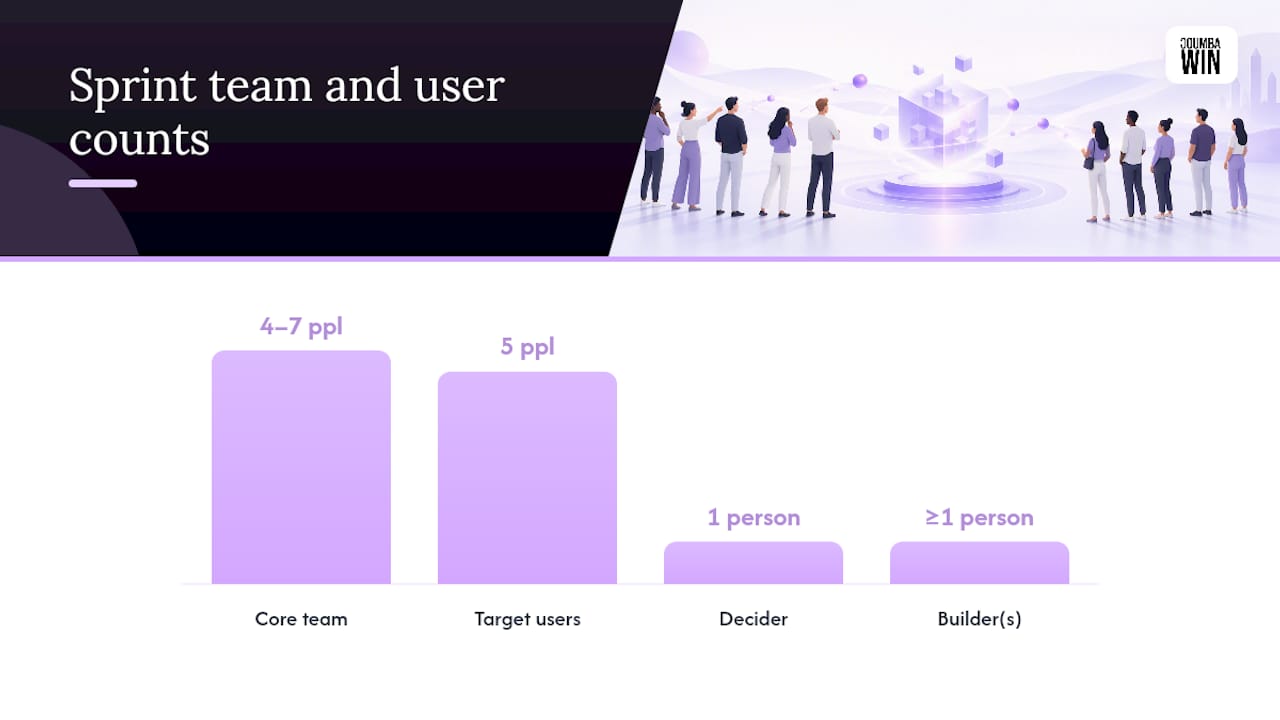
- A Decider who can make the Wednesday call and stays present all week
- Four to seven cross-functional teammates (design, product, engineering, and someone customer-facing)
- At least one person who will actually build the post-sprint work, so buy-in carries forward past Friday
Recruit five target users days ahead, not the night before. Overbook slightly since one no-show is normal, and pick people who actually match your customer profile, not friends who’ll be too polite to get confused on camera. Reserve a dedicated room for the week and treat it as sacred. No drop-ins, no “quick syncs” bleeding into sprint hours.
Pro Tip: Block the whole week on every participant’s calendar before you send the Sprint Question. A half-attended sprint produces half a decision.
How to Prototype Fast Without Overbuilding
The prototype only needs to survive one conversation with a user, not a code review. GV calls this Goldilocks quality: rough enough to build in a day, polished enough that testers forget it’s fake. Production code is wasted effort here. You’re building a facade that answers one question, then it gets thrown away.
Thursday’s build works best with quick role splits: one person stitches screens together in a tool like Figma or Keynote, another writes believable copy, another gathers stock assets or real product screenshots. Teams prototyping an interactive flow can borrow ideas from real interactive feature examples to make the fake version feel more real.
What the prototype must do:
- Let a tester complete the one task tied to your Sprint Question
- Look and feel close enough to real that reactions are honest
What it should skip entirely:
- Backend logic, database connections, or account creation
- Every screen that isn’t on the path to the tested moment
How Do You Run and Read a Sprint’s Test Day?
Friday runs on five back-to-back one-on-one sessions, each about 45 to 60 minutes, moderated by one team member while the rest observe from another room. The moderator asks the tester to complete a task and stays quiet otherwise. Note takers track what actually happened: where testers hesitated, what confused them, direct quotes, and moments of real enthusiasm versus polite nodding.
The math behind five testers: research on usability testing shows that about five users surface roughly 85% of usability issues in a given flow, based on Jakob Nielsen’s original findings. Teams needing more statistical confidence sometimes stretch to 10 to 20 participants across live and async sessions, but five is the standard startup sprint sample.
To synthesize fast:
- Track patterns in an observation grid, one column per tester
- Flag anything that repeats by session three or four
- Hand the Decider a short summary, not a raw transcript
The Decider then picks one of three paths: pivot the concept, refine and retest, or greenlight a small MVP slice built from what worked.
What Mistakes Ruin a Startup’s Design Sprint?
Most failed sprints trace back to one of four setup errors, all fixable before Monday even starts.
- Vague Sprint Question. “Improve onboarding” isn’t testable. Rewrite it as a specific behavior you can watch someone attempt or fail.
- No Decider. Sprints without one often end in materials, not decisions, because nobody has authority to close Wednesday’s debate. Name the Decider before recruiting is even finished.
- Interrupted week. One canceled afternoon breaks the whole rhythm. Lock the calendar and treat sprint hours like a client meeting nobody reschedules.
- Overbuilt prototype. Teams that chase polish burn Thursday on details nobody will test. Trim ruthlessly to the single moment your question actually needs.
Why Facilitation Experience Changes Sprint Quality
A sprint run without prior facilitation experience tends to drift, long debates on Monday, a rushed Thursday build, testing sessions that wander off script. An experienced design partner working directly with founders keeps sprints focused on outcomes instead of process for its own sake. Experienced facilitation protects the Decider’s authority, tightens prototype fidelity, and turns Friday’s raw observations into a usable roadmap instead of a pile of sticky notes.
Design Sprint for Startups: Run a 5-Day Prototype and Test
Most sprint guides treat the methodology like scripture, five days, no deviations, follow the book exactly or you’ve failed. That advice ignores how startups actually operate. You don’t have a UX research team on standby or six weeks to recruit the “perfect” five testers. What you have is a founder, three or four teammates, and a real deadline breathing down your neck.
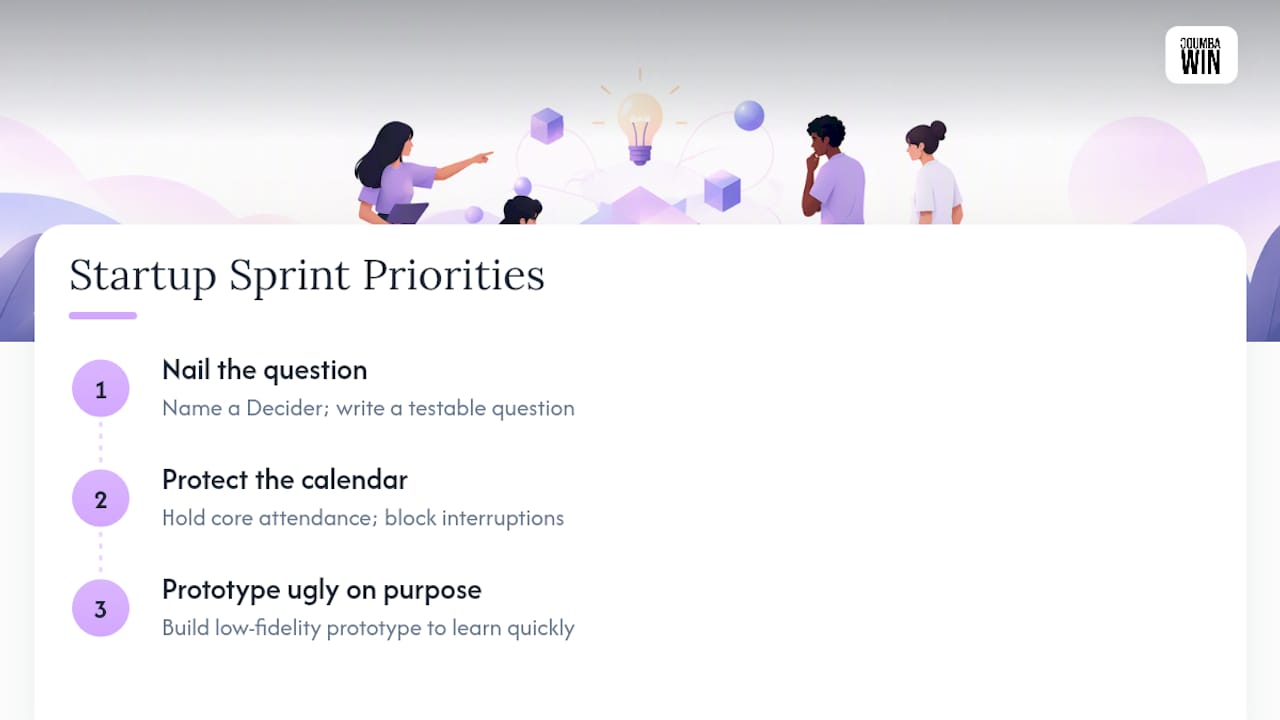
The research backs a leaner read: Jake Knapp’s original framing was built for exactly this kind of team, and even GV’s own kit acknowledges compressed four-day variants work when full attendance for five days isn’t realistic. The part startups consistently under-invest in isn’t the sketching or the prototyping. It’s naming a real Decider and writing a Sprint Question specific enough to fail. Skip either one and you’ll spend a polished week producing an expensive shrug.
Prioritize this order: nail the question first, protect the calendar second, keep the prototype ugly on purpose third. Everything else is decoration.
— Coumba Evelyn
Need Help Running Your Startup’s Design Sprint?
Running your first sprint solo is doable. Running it well, with a Decider who stays firm, a prototype that doesn’t balloon into a real build, and five test sessions that actually get synthesized by Friday, is where most founders lose steam. A design partner can facilitate startup design sprints directly with founders, covering planning, day-of facilitation, prototype build support, and structuring the Friday user tests so patterns actually surface.
Unlike a generic agency retainer, this is built around the sprint itself: a focused week of hands-on design partnership instead of a vague ongoing engagement. If your prototype needs a real interface fast, Coumba Win Design’s UI and UX design work turns Thursday’s facade into something closer to a real product, and the portfolio of past projects shows how those prototypes evolved past the sprint. Reach out through Coumbawin to scope your sprint and get a facilitation plan back within days.
Sources
- Design Sprint methodology - GV / Google
- Understanding Design Sprints & Their 5 Key Phases - Atlassian
- Usability test: how many users? - UX Design Institute
- What is a design sprint? - Miro research & design
FAQ
How Long Does a Design Sprint Take to Plan?
Plan for at least one full prep day for every sprint day, so roughly a week of setup before the sprint itself, according to GV’s own sprint guidance. Skipping prep is the fastest way to waste Monday on a weak target.
Can a Startup Run a Shorter, Four-Day Sprint?
Yes. Compressed formats preserve the same deliverables while cutting stakeholder attendance time, which helps when a full five-day commitment isn’t realistic for a small team.
Why Test With Only Five Users?
Testing with about five target users surfaces roughly 85% of usability issues in a given flow, based on Jakob Nielsen’s research. Teams needing higher confidence can expand to 10 or 20 participants across sessions.
What Happens if There’s No Decider?
Sprints without a dedicated Decider often produce materials instead of an actual decision, since nobody has the authority to close debates on Wednesday. Naming the Decider before recruiting testers is one of the most reliable fixes.
Can Coumba Win Design Facilitate Our Sprint?
Yes. Coumba Win Design works directly with founders on sprint planning, day-of facilitation, prototype build support, and structuring Friday’s user tests. Details on scoping a sprint are available at Coumbawin.