10 Brand Narrative Examples for Startups: Templates, Metrics, Design
10 Brand Narrative Examples for Startups: Templates, Metrics, Design
Okay, so here’s what you’re getting: ten annotated brand narrative examples, a repeatable narrative architecture you can steal for your own brand, and a way to measure whether any of it is working. No fluff, no “once upon a time” filler. If you’re a marketer, founder, or brand strategist trying to figure out why some stories stick and yours maybe doesn’t, this is your cheat sheet. Grab a coffee, this one’s dense but worth it.
TL;DR:
- A strong brand narrative focuses on the customer as the hero, with clear conflict, resolution, proof, and recurring rituals that reinforce the story.
- Building a single narrative spine supported by three to five pillars prevents miscommunication and maintains brand consistency across channels.
- Measuring success involves tracking brand lift, engagement, retention, customer sentiment, and behavior changes, while qualitative signals include community messaging.
- Regular audits of proof points and cultural relevance every year ensure the narrative stays current without requiring a full rebrand.
- A designated design partner can translate your narrative into cohesive website, pitch, and packaging designs, maintaining consistency and clarity.
Table of Contents
- What is a brand narrative, and why does it matter more than your tagline?
- What makes a great brand narrative: the elements and patterns that keep showing up
- 10 brand narrative examples (and the “why it works” behind each one)
- How to craft your own brand narrative: a compact, repeatable template
- How do you actually measure whether your brand narrative is working?
- Coumba Win case summaries: narrative-led design that moved the needle
- How to adapt and evolve your brand narrative without losing the thread
- How do you keep a brand narrative consistent across every marketing channel?
- The single biggest mistake brands make with their narrative
- How Coumba Win can help you turn narrative into design that actually works
- Sources
- FAQ
What is a brand narrative, and why does it matter more than your tagline?
A brand narrative is not your mission statement, and it’s definitely not a list of product features dressed up in nicer font. It’s the ongoing story about who your customer becomes when they choose you, what they’re fighting against, and what changes because of it. The customer is the hero. Your brand is the guide, the tool, the thing that shows up at the right moment, think Yoda, not Luke.
This matters because research from Harvard Business School frames brand managers as “meaning makers”: brands work as relational assets that people use to construct their own identity, not just functional tools that solve a problem. That’s a bigger job than most companies realize.
Quick distinctions worth keeping straight:
- Story: a single, specific moment or anecdote (the founder’s garage, the first customer).
- Narrative: the throughline connecting many stories into one coherent arc over time.
- Messaging: the tactical language (taglines, ad copy, value props) that expresses the narrative in a given channel.
Mix these up and you get a brand that feels scattered, technically consistent but emotionally forgettable.
What makes a great brand narrative: the elements and patterns that keep showing up
Every brand narrative that actually lands has four load-bearing parts, and honestly, if you’re missing one, the whole thing wobbles.
- A protagonist (almost always the customer, not the company)
- A conflict (the status quo, an industry frustration, a cultural tension)
- A moral or resolution (what changes, what the customer gains, who they become)
- Proof (receipts: actions, products, policies that back up the claim)
On top of that structure, a handful of patterns keep repeating across industries because they work:
- Underdog: the scrappy challenger taking on an entrenched giant.
- Mission-driven: the brand exists because of a cause bigger than the product.
- Customer-as-hero: the brand steps back entirely and lets the customer’s transformation carry the story.
- Identity and personalization: the brand reflects the customer’s taste back at them, often through data.
- Seasonal or reveal moments: a recurring cultural event the brand owns (think annual recaps or product drops).
Here’s the part most teams skip: building an actual narrative architecture instead of a one-off story. Practitioner analysis on rebuilding creative identity recommends defining a single narrative spine (a one-sentence kernel of the story), three to five supporting pillars, and channel-specific playbooks so your social team, your sales deck, and your website aren’t all telling slightly different versions of who you are. Skip this step and you get what practitioners call “hero confusion,” where the brand accidentally casts itself as the main character and the customer disappears.
Pro Tip: Write your narrative spine as one sentence a new hire could repeat from memory. If it takes a paragraph, it’s not a spine yet, it’s a mission statement.
10 brand narrative examples (and the “why it works” behind each one)
These ten span categories on purpose: apparel, personal care, audio, hospitality, sportswear, tech, eyewear, enterprise software, beauty, and streetwear. Pull the pattern, not the brand.
- Patagonia: Protagonist is the planet, conflict is corporate extraction, resolution is Patagonia transferring ownership structure to fight climate change. The narrative works because the brand’s biggest actions (not just ad copy) back the story, which is the kind of narrative-action alignment that builds durable credibility over campaign cycles. Adaptation idea: audit one policy or operational decision your company has made that proves your mission, then build messaging around that instead of a slogan.
- Dove: Protagonist is the everyday woman, conflict is the beauty industry’s narrow standards, resolution is “real beauty” representation across campaigns. It works because it names a cultural tension people already feel and takes a visible side. Adaptation idea: find the industry assumption your customers are quietly frustrated by and build your pillar content around challenging it.
- Spotify: Protagonist is the individual listener, conflict is “nobody else really gets my taste,” resolution is Wrapped turning personal data into a shareable identity moment. Personalization and first-party data let the brand scale an identity story that millions of people repost without being asked. Adaptation idea: if you have any customer usage data, build one annual or quarterly “reveal” that turns behavior into a shareable identity artifact.
- Airbnb: Protagonist is the traveler who wants to “belong,” conflict is the impersonal, transactional feel of traditional hotels, resolution is living like a local anywhere. It works because the narrative reframes an entire category (travel) around emotional belonging instead of logistics. Adaptation idea: identify the emotional need underneath your functional category and lead with that instead of features.
- Nike: Protagonist is “the athlete in all of us,” conflict is self-doubt and inertia, resolution is “Just Do It,” action over excuses. The pattern is customer-as-hero taken to its most extreme: Nike rarely talks about shoes at all. Adaptation idea: strip your messaging down and ask what it would look like if you never mentioned your product directly for a full campaign cycle.
- Apple: Protagonist is the creative misfit, conflict is conformity and bloated complexity, resolution is simple tools that let weird, brilliant people make things. “Think Different” is an identity narrative, not a spec sheet. Adaptation idea: define who your product makes someone feel like, then build copy entirely around that feeling.
- Warby Parker: Protagonist is the frustrated customer facing overpriced, inconvenient eyewear, conflict is a broken industry model, resolution is affordable glasses with a mission-driven buy-one-give-one structure baked in. The underdog pattern works here because the company names the industry’s dysfunction directly. Adaptation idea: say out loud what’s broken about your category before explaining how you fixed it.
- Salesforce: Protagonist is the business leader drowning in disconnected tools, conflict is fragmented customer data, resolution is a unified platform plus a visible community and philanthropic commitment (the 1-1-1 model). It works because B2B narrative doesn’t have to be dry, Salesforce built an entire conference culture (Dreamforce) around its story. Adaptation idea: give your B2B narrative a recurring event or ritual, not just a webinar series.
- Glossier: Protagonist is the real customer, conflict is an industry obsessed with transformation and flaws, resolution is “skin first, makeup second,” community-sourced product development. The brand built its narrative from actual customer comments, which is customer-as-hero taken literally. Adaptation idea: mine your own reviews or support tickets for language you can turn directly into messaging.
- Supreme: Protagonist is the insider who gets it, conflict is mainstream, mass-produced everything, resolution is scarcity-driven belonging through weekly drops. It works because the narrative is performed through behavior (limited drops, lines around the block) rather than explained through copy. Adaptation idea: consider whether scarcity or exclusivity, even a small version of it, could make your audience feel like insiders.
How to craft your own brand narrative: a compact, repeatable template
Here’s the process, broken into two phases so it doesn’t feel like homework.
Phase one: audit
- Who is your audience becoming, or trying to become? (Not “who buys from us,” but “who do they want to be?”)
- What’s the cultural context or tension your category sits inside right now?
- What proof points (policies, product decisions, data) already exist that back up a story you haven’t told yet?
Phase two: build
- Name your protagonist (almost always the customer).
- Name the conflict (status quo, industry frustration, internal doubt).
- Name the moral or resolution (what changes because of your brand).
- Define rituals or recurring behaviors that reinforce the story (an annual report, a community event, a seasonal drop).
- Write channel treatments: how does this spine show up on your homepage versus a sales deck versus a thirty-second ad?
Template prompt to steal: “[Customer] used to struggle with [conflict]. Now, because of [proof point], they can [resolution].” Run your own brand through that sentence and see if it holds up without sounding like a brochure.
If you’re translating this into an actual website experience, website storytelling techniques for startups covers how to turn a narrative spine into real UX decisions instead of just homepage copy.
Pro Tip: Build your channel treatments before you touch final design. A gorgeous homepage built on a vague story just means the confusion loads faster.
How do you actually measure whether your brand narrative is working?
Narrative work feels soft until you attach numbers to it, so here’s where to look.
- Brand lift: shifts in awareness, favorability, or purchase intent, usually tracked through surveys before and after a campaign.
- Engagement: share rate, comment sentiment, time spent with branded content.
- Retention and repeat behavior: whether people come back, not just whether they clicked once.
- Net Promoter Score: a proxy for whether the identity story is landing emotionally.
- First-party activation metrics: sign-ups, account creation, or usage tied directly to a narrative-led campaign.
Qualitatively, watch the tone of your community (are people repeating your language back to you unprompted?) and the themes showing up in earned media or reviews.
Underdog brand biographies increase purchase intent and loyalty by letting consumers connect to the brand’s struggle, according to research referenced by Harvard Business School, which is a useful benchmark if your narrative leans on an origin story. A lightweight way to test any of this: run an A/B experiment on a landing page or ad set, swap the headline or narrative framing while holding everything else constant, and measure micro-conversions and share rates before scaling the winning variant.
Coumba Win case summaries: narrative-led design that moved the needle
Design work only matters if it changes how people behave, so here’s what that’s looked like in practice.
- Educational platform: Coumba Win rebuilt the user experience around a narrative-driven approach, clarifying who the platform served and what success looked like for them, which translated into measured engagement gains across the redesigned flows.
- High-end apparel brand: the engagement focused on refining the brand narrative itself, sharpening protagonist and proof points, which fed directly into brand lift and conversion outcomes tied to the new positioning.
When should you bring in a design partner instead of iterating alone? Generally, when your internal team can describe the narrative but can’t translate it consistently across web, deck, and print, or when speed matters more than building that capability in-house from scratch.
How to adapt and evolve your brand narrative without losing the thread
A brand narrative isn’t a plaque you hang once. Culture shifts, your customer base matures, and what felt fresh two years ago can start to feel stale or, worse, tone-deaf. The fix isn’t a full rebrand every year, it’s a scheduled audit.
Executive education work out of Harvard Business School emphasizes iterative audits and community co-creation as practical governance steps for keeping brand meaning aligned with cultural shifts over time, rather than letting the story calcify. That typically means revisiting your narrative spine annually, checking whether your proof points still hold up, and listening to how your community talks about you versus how you talk about yourself. If there’s a gap, that gap is your next narrative move.

The biggest trap here is treating evolution as rebranding. Most of the time, your core spine (the protagonist, the central conflict) stays intact for years. What evolves is the proof and the moment: new rituals, new channels, new cultural references that make the same underlying story feel current. Supreme’s drops still work because the scarcity pattern persists even as the specific products change constantly.
How do you keep a brand narrative consistent across every marketing channel?
This is where most narrative work quietly falls apart. The story is sharp in the brand deck and then gets diluted the moment it hits a landing page, an email, or a paid ad, because different teams, agencies, or freelancers interpret the spine differently without a shared playbook.
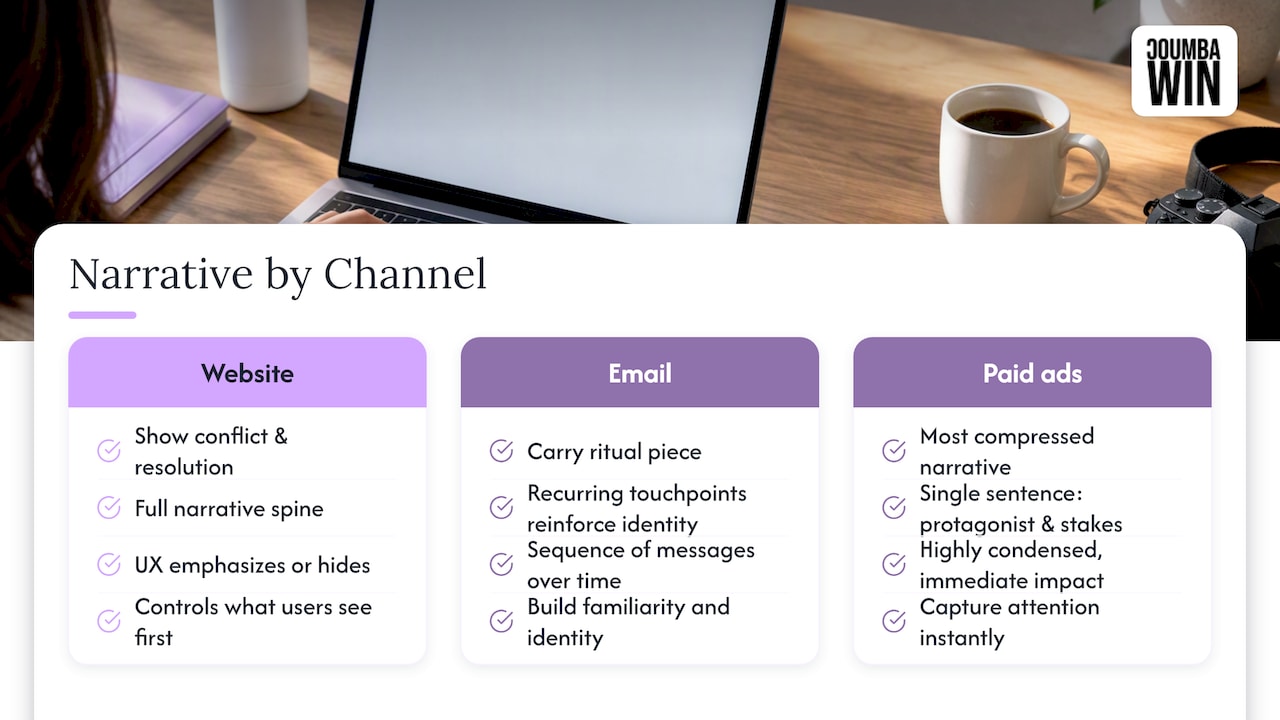
The fix is treating your channel treatments as part of the narrative architecture itself, not an afterthought. Your website should show the conflict and resolution through UX decisions (what’s emphasized, what’s hidden, what the customer sees first). Email can carry the ritual piece, recurring touchpoints that reinforce identity over time. Paid ads usually need the most compressed version of the spine, a single sentence that still carries protagonist and stakes.
For more on translating narrative into digital distribution and measurement across platforms, digital strategy guidance for modern brands breaks down how narrative choices should shift depending on where your audience actually spends time. A story that works as a thirty-second video needs a different compression than one that has to hold up in a static social post, and treating every channel identically is usually how brands end up sounding like a committee wrote them.
The single biggest mistake brands make with their narrative
Hero confusion. It’s the thing that quietly kills more brand narratives than bad design or weak budgets ever could: the brand casts itself as the protagonist instead of the customer. Fix that one structural error and most other narrative problems get easier to solve.
Beyond that, commit resources like you mean it. A narrative sustained over years beats a flashy one-off campaign every time, and for startups specifically, scale your ambitions to your actual timeline. You don’t need Nike’s budget to get the structure right, you need the structure.
— Coumba Evelyn
How Coumba Win can help you turn narrative into design that actually works
Figuring out your narrative spine is half the work. Translating it into a website, a pitch deck, or a Demo Day booth that doesn’t water it down is the other half, and that’s where most startups lose the thread.
A design partner can help you with branding, web design, UI and UX, pitch decks, and Demo Day kits, all built around the idea that your narrative should show up consistently whether someone’s reading your homepage or holding your business card. Unlike generic templates, the collaboration starts with your story and builds outward, so the design reinforces the narrative instead of competing with it. Check out past projects and outcomes to see how that’s played out for other founders, or head to the main services page to talk through what your brand needs right now.
Sources
Research on brand meaning from Harvard Business School covers the academic case for identity-driven branding. For a practitioner’s take on digital storytelling’s role in brand authority, this analysis from Tradewinds United Media is worth a read.
- Jill J. Avery - Faculty & Research - Harvard Business School
- How Caraway home rebuilt its creative identity around emotion not function (D2C Times)
- Consumer Brands Today: Q&A with Jill Avery | Executive Education
FAQ
What is a brand narrative in simple terms?
A brand narrative is the ongoing story of who your customer becomes through their relationship with your brand, built around a protagonist, a conflict, and a resolution. It’s different from a tagline or mission statement because it has to hold up across many touchpoints and years, not just one campaign.
What are some examples of brand narratives done well?
Patagonia, Nike, Airbnb, and Glossier are frequently cited examples, each built around a distinct pattern: environmental activism, self-belief, belonging, and customer-sourced authenticity. Each works because the customer, not the company, is positioned as the hero of the story.
How do you measure the success of a brand narrative?
Common metrics include brand lift surveys, engagement and share rates, retention, Net Promoter Score, and first-party activation like sign-ups tied to narrative-led campaigns. Qualitative signals, like whether your community repeats your language unprompted, matter just as much.
How often should a brand narrative be updated?
Most practitioners recommend an annual or periodic audit rather than a full rebrand, checking whether your proof points and cultural context still align with your core story. The underlying spine, your protagonist and central conflict, usually stays stable for years even as specific proof and rituals evolve.
Does Coumba Win help startups build their brand narrative?
Yes, Coumba Win works with founders on branding, web design, UI and UX, and pitch decks, with the narrative as the foundation the design builds from. Pricing for these services is available on request through their main services page.