Make Heritage Work: Six Step Luxury Storytelling for Brand Leaders
Make Heritage Work: Six Step Luxury Storytelling for Brand Leaders
The best luxury brand storytelling leans on sensory, provenance-led narratives that invite customers to become co-authors, not just spectators. Get this right and you see deeper engagement, more price resilience, and a bigger share of voice in a crowded feed. Get it wrong (all polish, no truth) and the story evaporates the second the ad stops running.
TL;DR:
- Heritage storytelling can backfire on close-to-self products like cosmetics, but works well for distant-from-self categories such as watches and leather goods.
- Sensory details, narrative friction, and scarcity are crucial elements, with specific and textured descriptions making stories more memorable and authentic.
- Audience segmentation requires tailored scripts: transparency and co-creation appeal to Gen Z, experience-based access attracts aspirational buyers, and provenance-focused, high-touch channels resonate with UHNWIs.
- Launch strategies should integrate scarcity mechanics like limited drops or invite-only access within the story rather than as afterthoughts, to heighten audience engagement.
- Consistent messaging across formats, from atelier visits to digital showrooms and creator collaborations, defines the effectiveness and longevity of luxury brand storytelling.
Table of Contents
- Why luxury storytelling works differently: scarcity, meaning, and provenance
- Core elements: a practical framework to build a luxury brand story
- Methods and platforms: choosing format and channel for luxury narratives
- Audience-specific strategy: tailoring stories for Gen Z, aspirational buyers, and UHNWIs
- Short examples and micro case studies to illustrate the framework
- Six-step playbook: craft, produce, launch, and measure a luxury brand story
- Research-backed insights and practitioner notes
- How Coumba Win applies these principles in practice
- Ready to build a story your brand can defend
- Sources
- FAQ
Why luxury storytelling works differently: scarcity, meaning, and provenance
Here’s the thing about luxury: the product rarely justifies its price on function alone. A $400 candle burns the same as a $12 one. What you’re actually buying is meaning, and meaning is built through story, not spec sheets. HBR’s research on customer emotions shows that brands creating strong emotional connections with customers build the kind of memory structures that turn a one-time purchase into a decade of loyalty. That’s the whole game for luxury: manufacture desirability, then let cultural capital do the rest.
Heritage is the most obvious lever, but it’s not a universal one. Academic research on brand heritage found that heritage-heavy storytelling can actually backfire for close-to-self products like perfume or cosmetics, things you put directly on your body, where a distant, archival tone can read as cold or disconnected. The same heritage narrative performs far better on “distant-from-self” categories: watches, leather goods, cars. Know which bucket your product sits in before you write a single word about your founder’s grandfather.
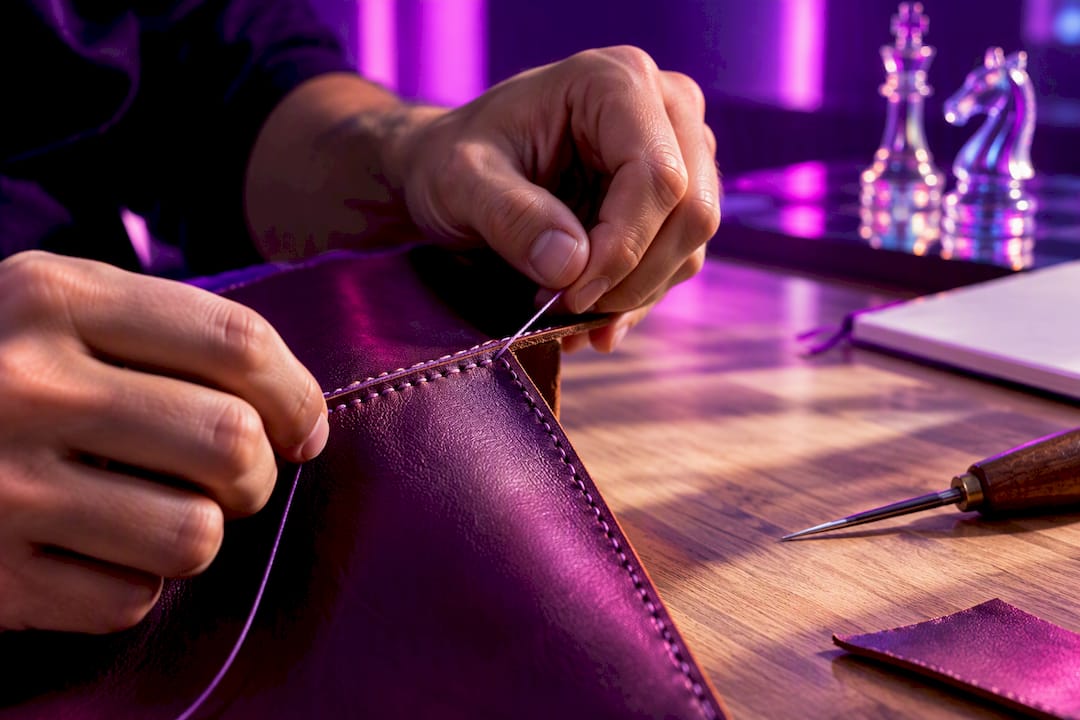
This is why sensory detail and narrative friction matter so much. A story that’s too smooth, too resolved, too “brand safe,” reads as manufactured. The stories that stick have texture: the smell of tanned leather in an atelier, the specific imperfection of a hand-stitched seam, a small tension in the founder’s history that never quite gets tidied up. Exclusivity works the same way. Scarcity isn’t a marketing trick bolted onto the story, it’s part of the story itself: fewer people got to see this, touch this, hear this, and that fact becomes the plot.
Core elements: a practical framework to build a luxury brand story
Every strong luxury narrative rests on the same six load-bearing pieces, whether the deliverable is a 90-second film or a single Instagram caption.
- Brand truth and archetype: one sentence that’s true about the brand and could not be said by a competitor.
- Protagonist and ritual: a person (founder, artisan, customer) and a repeatable action that carries meaning.
- Provenance and craft: the specific origin, material, or technique that proves the claim rather than asserting it.
- Sensory palette: three to five concrete sensory details (texture, sound, smell) locked into the brief so every asset stays consistent.
- Narrative device: the structural choice, reveal, contrast, or unfinished thread, that keeps the story from feeling closed and complete.
- Point of tension: something slightly unresolved that invites the audience to fill in the rest.
The difference between a forgettable campaign and a memorable one usually comes down to small choices at the brief stage. Specifying “warm brass, worn oak, low afternoon light” instead of “warm, inviting tones” gives a director something to actually shoot. Naming the artisan instead of writing “our craftsmen” turns an abstraction into a protagonist. These aren’t stylistic flourishes, they’re the difference between a story people repeat and one they scroll past.
Methods and platforms: choosing format and channel for luxury narratives
Format should follow strategic goal, not budget or trend. An atelier visit or private dinner works when the goal is deepening loyalty with an existing high-value customer, since it trades reach for intimacy. A cinematic film works when you need to establish or reset brand meaning at scale, because it controls pacing and sensory detail completely. An immersive WebGL or 3D showroom works when you’re trying to reach a younger, digitally native audience who expects to explore rather than watch.
- Atelier or salon experience: best for retention and UHNWI relationship-building, worst for reach.
- Cinematic short film: best for repositioning or launch moments, needs the biggest production budget.
- Digital immersion (WebGL, 3D): best for Gen Z and aspirational buyers who want to “step inside” the story.
- Creator co-authorship: best for earned narrative value and lower acquisition cost over time.
Scarcity mechanics should be planned into the launch calendar itself, not tacked on as a press release line. Staggered access, invite-only previews, and limited-run drops all work because they make the story something you had to be present for. Our website storytelling techniques for startups piece covers how to translate this pacing into a digital brief, which applies just as well to luxury as it does to early-stage brands.
Audience-specific strategy: tailoring stories for Gen Z, aspirational buyers, and UHNWIs
The same brand truth needs three different scripts depending on who’s listening. Kantar’s research found that 84% of young luxury buyers see luxury as an immersive experience rather than a possession, and 51% would rather hear the story from a creator than a marketer. For Gen Z, that means transparency about sourcing, real co-creation opportunities, and framing purchases as “special occasion” moments rather than routine acquisitions.
Aspirational buyers, the largest growth segment, respond to a different lever: monetized experience. EY’s research on this segment shows many would pay for exclusive events and are open to subscription or certified pre-owned models when those are framed with clear provenance. That means the story isn’t just about the product, it’s about the access model itself becoming part of the narrative.
UHNWIs want the opposite of scale: provenance, craft, and legacy told through high-touch, low-reach channels. A private atelier tour or a handwritten note from an artisan carries more weight here than any digital campaign ever could. The Luxonomy report on the post-2030 consumer projects that growth will increasingly come from younger, more diverse buyers, which means brands need to run all three playbooks simultaneously rather than picking one.

Short examples and micro case studies to illustrate the framework
Three quick executions show how the framework plays out in practice.
- Heritage reframe (archive remix): a heritage house pulls an original 1960s sketch from its archive and rebriefs it as the hero asset for a new bag, replacing generic “timeless elegance” copy with the actual designer’s handwritten notes. The lesson: provenance proof beats provenance claims every time.
- Co-authored drop: a brand ships a limited run with a narrative toolkit, prompts, templates, ceremony language, so customers document their own “first wear” moment. Research on consumer co-creation and heritage branding found this kind of participation model extends organic reach and lowers acquisition cost, because the audience becomes the media channel.
- Digital immersion showroom: instead of a static product page, a brand builds a slow-reveal 3D space where scrolling unlocks craftsmanship details one at a time, mimicking the pacing of an in-person unveiling. The brief note here matters: treat the digital showroom like a physical atelier, curated navigation and a slow reveal, not a spinning product shot.
Each example uses a different tool from the same six-part framework, which is the point: the elements stay constant, the execution shifts with the goal.
Six-step playbook: craft, produce, launch, and measure a luxury brand story
This is the operational version of everything above, written as a brief you can actually hand to a team.
- Audit existing provenance, proof points, and narrative gaps: what’s true, what’s provable, and what’s currently unsaid.
- Map the audience and objective: decide whether this story needs to reach, retain, or convert, and for which segment (Gen Z, aspirational, UHNWI).
- Build the narrative toolkit: lock tone, sensory palette, key scenes, and the specific assets each channel needs.
- Write the production brief: specify materials, locations, protagonist, and craft details concretely enough that a director or designer can’t default to generic imagery.
- Choreograph the launch: decide the scarcity mechanics (invite-only, staggered drops, limited runs) and where earned media fits before paid media does.
- Measure what actually matters: engagement quality (saves, shares, dwell time) over raw reach, plus any shift in price sensitivity or willingness to pay full price at re-stock.
Pro Tip: Brief the sensory palette before the shot list. If your director doesn’t know the specific smell, sound, or texture you’re chasing, the footage will look expensive and say nothing.
Measurement is where most luxury teams get lazy, defaulting to impressions because they’re easy to report. Better proxies include repeat engagement with a single asset (a sign the story has legs), unprompted creator mentions, and, over a longer window, resistance to discounting during a sale period. None of these show up in a weekly dashboard, but they’re the signals that actually correlate with the brand equity you’re trying to build.
Research-backed insights and practitioner notes
A few findings are worth keeping pinned above your desk. Gen Z buyers expect transparency and traceability, and Kantar’s data shows 51% actively prefer hearing brand stories from creators rather than from the brand itself, which should shape how much control you’re willing to hand over. Heritage storytelling isn’t a universal solve: the EM Lyon research is specific that it underperforms on close-to-self categories, so test before you scale it. And the market itself is shifting underneath these tactics: Luxonomy’s forecast points to a younger, more diverse buyer base driving growth through 2030, with experiential and subscription models becoming legitimate monetization tools rather than side experiments.
How Coumba Win applies these principles in practice
We build brand narratives the same way we build brand identities: starting from a truth the founder can actually defend, then designing every touchpoint, website, UI, print, pitch deck, around that truth instead of a template. If you want to see how this plays out for a real brand, our team can walk you through relevant project examples on request.
— Coumba Evelyn
Ready to build a story your brand can defend
If you’re a founder trying to turn a real brand truth into a narrative that holds up across your website, pitch deck, and launch materials, that’s the exact problem Coumba Win solves. We work directly with founders who see design and narrative as a strategic edge, not a line item, building custom brand identities, sites, and UI/UX rather than pulling from a template library.
An initial engagement usually starts with a narrative and brand audit, the same audit outlined in the playbook above, followed by a tailored build across whichever touchpoints matter most for your launch. You can see examples of past narrative-driven work on our portfolio or start a conversation about your project at Coumbawin.
Sources
For deeper reading: Kantar’s research on Gen Z luxury behavior, Luxonomy’s post-2030 consumer profile, EY’s report on aspirational luxury consumers, and the academic study on brand heritage limits. For broader tactics, see this partner piece on storytelling and engagement.
- The alchemy of luxury: Where Gen Z fuses sustainability, storytelling, and self-image (Kantar)
- LUXONOMY Report: Profile of the New Post-2030 Luxury Consumer
- How aspirational consumers are reshaping luxury growth (EY)
- The limits of brand heritage in luxury advertising (EM Lyon / academic study)
- The new science of customer emotions (Harvard Business Review)
FAQ
Can you give an example of luxury brand storytelling?
A common approach is an archive remix: a heritage brand pulls an original sketch, letter, or photograph from its own archive and rebriefs a campaign around that specific artifact instead of generic heritage language. This kind of provenance proof tends to land better than a broad claim about legacy or timelessness.
What are the 5 C’s of storytelling?
Definitions vary across marketing frameworks, but a common version covers character, conflict, context, curve (the arc of change), and conclusion. In a luxury context, the “character” is usually the founder or artisan, and the “conflict” is the tension or imperfection that keeps the story from feeling too polished.
What is the 3-7-27 rule of branding?
This isn’t a standardized industry framework with a single agreed definition, so treat any specific numbers attached to it with caution. The underlying idea some practitioners use, repeated exposure across a small number of touchpoints builds recall, is worth applying loosely rather than as a fixed formula.
What are the 8 P’s of luxury brand marketing?
There’s no single, universally cited model enumerating a specific number of 'P’s for luxury marketing; the term gets used differently across sources. What does hold up consistently, based on the research here, is that provenance, protagonist, and platform choice matter more in luxury than in mass marketing, regardless of which acronym a given framework uses.