Growth Driven Design: Replace Guesswork With Tests for Startups
Growth Driven Design: Replace Guesswork With Tests for Startups
Growth driven design (GDD) is an iterative, data led website process that launches fast and improves in measured cycles instead of betting everything on one big redesign. It swaps the “disappear for six months and pray” model for a three stage structure: strategy, launch pad, continuous improvement. The payoff is lower upfront risk, a quicker time to value, and a site that keeps getting smarter after launch.
TL;DR:
- Choose one focus metric for each cycle, record its baseline, and review leading and lagging indicators every sprint rather than tracking everything.
- Test one page element at a time against a control, using analytics, heatmaps, recordings, and user interviews to explain both what changed and why.
- Choose sprints lasting two weeks for teams that move quickly, or monthly cycles for leaner teams, and fund the launch pad separately from ongoing improvement work.
- Make SEO a recurring experiment: change titles, links, or headings page by page, then monitor rankings and organic traffic instead of relaunching everything at once.
Table of Contents
- What Growth Driven Design Actually Means
- The Three Stages, Step by Step
- The Day to Day: Data, Testing, and Conversion Focused Tactics
- GDD Versus the Traditional Redesign
- Rolling GDD Out at Your Company
- Setting Goals and KPIs That Actually Mean Something
- Getting Stakeholders Actually Involved (Not Just Informed)
- Where SEO Fits Into Continuous Improvement
- User Research and Testing Done Right
- GDD and the Startup Growth Curve
- Our Take on GDD for Startups
- Ready to Put GDD to Work? Here’s How We Can Help
- FAQ
- Sources
What Growth Driven Design Actually Means
Okay, so here’s the thing about traditional redesigns: you spend months guessing what visitors want, launch a shiny new site, and then just… hope. GDD throws that gamble out the window and replaces it with something closer to a lab experiment. Growth design treats a website the way a scientist treats a hypothesis: you observe real behavior, test a change, measure what happens, and scale what works. That’s a different muscle than traditional product design, which leans more on conceptual problem-solving before anything ships.
GDD rests on three pillars that we’ll unpack in the next section, but here’s the quick preview:
- Strategy: the research and planning phase that sets goals, personas, and a focus metric.
- Launch pad: a smaller, faster site built to get you live and gathering data.
- Continuous improvement: ongoing sprints that test, learn, and refine indefinitely.
Prioritization glues all of this together. Every idea for the site, from a new headline to a redesigned checkout flow, lands on a wishlist first. From there it gets scored on impact versus effort, so the team is always working on the highest leverage item rather than whatever the loudest stakeholder wants that week. Conversion centered design principles slot right into this process, giving the experiment backlog actual techniques to test rather than vague hunches.
The Three Stages, Step by Step
Think of these three stages as acts in a play, each with its own job and its own pacing.
- Strategy: this is where goals get sharpened into something measurable. You build personas, map the buyer’s journey, write hypotheses about what’s blocking conversions, and pick one focus metric everyone agrees to chase. The output is a prioritized roadmap, not a mood board.
- Launch pad: instead of building every page and feature up front, you ship a leaner version of the site fast, with only the content and functionality that matter most right now. The point is speed: get something real in front of visitors so you have actual data instead of assumptions. HubSpot’s GDD framework%20-%20Growth-Driven%20Design/Slide%20Decks%20PDF/1.%20What%20is%20GDD.pdf) describes this as a core reason agencies report faster launch times compared with traditional redesign timelines.
- Continuous improvement: this is the part that never really ends. Teams typically run recurring sprint cycles, pulling the next few items off the experiment backlog, shipping changes, measuring lift against the focus metric, and feeding results back into the roadmap. Rinse, repeat, improve.
The beauty here is that nothing is permanent and nothing is wasted. A launch pad page that underperforms isn’t a failure, it’s data. You adjust, test again, and the site can compound its gains over time instead of staying frozen until the next major redesign.
The Day to Day: Data, Testing, and Conversion Focused Tactics
This is where GDD stops being a framework on a slide deck and starts being actual work. Teams pull from a handful of data sources to find out what’s really happening on the site:
- Analytics for traffic patterns, drop off points, and conversion funnels.
- Heatmaps and session replays for where people click, scroll, and get stuck.
- Surveys and interviews for the “why” behind the numbers analytics can’t explain.
Every experiment starts with a hypothesis (“changing the hero CTA copy will increase sign-ups”) and runs a control against a variant until there’s enough data to call it. If a variant wins clearly, you scale it site wide; if it’s a wash, you learn something and move to the next backlog item. Conversion centered design gives this process its toolkit: create focus, build a clear visual hierarchy, show trust signals, and strip out friction wherever it hides, as outlined in Webflow’s breakdown of conversion centered design. We’ve seen similar interactive features move the needle for startup sites when they’re tested rather than just shipped on a hunch.
To keep the backlog from turning into chaos, most teams score each idea on impact, confidence, and effort, then tackle whatever scores highest first.
Pro Tip: Run one experiment per page element at a time, or you won’t know which change actually caused the lift.
GDD Versus the Traditional Redesign
Traditional redesigns ask you to bet a big budget on a single launch and hope the market agrees with your guess later. GDD spreads that bet across smaller, faster cycles:
- Lower upfront cost exposure: launch pad sites are scoped smaller, so you’re not sinking a year’s budget into unproven pages.
- Reduced risk through validation: every change gets tested on real visitors before it becomes permanent.
- Compounding gains: instead of one redesign “event,” the site keeps improving every sprint.
HubSpot’s GDD materials report agency-observed outcomes that include faster launches and measurable lead or revenue uplifts after several months of continuous improvement, which is a sharp contrast to the traditional model where you wait, launch, and hope the redesign was right the first time.
Rolling GDD Out at Your Company
Adopting GDD doesn’t require a massive internal overhaul, but it does need a few things in place before the first sprint kicks off.
- Assemble a small core team: a growth designer (in house or an outside partner), a marketing or product lead who owns the focus metric, someone who can read the analytics, and engineering support to ship changes.
- Pick your cadence: two week sprints work well for fast moving teams, monthly works for leaner setups. Either way, build in a recurring roadmap review so priorities don’t go stale.
- Budget in two chunks: a smaller investment for the launch pad build, then an ongoing monthly retainer or sprint budget for continuous improvement. This spreads spend instead of front loading it all into one redesign.
- Run a starter checklist: audit your current site, define the one focus metric that matters most, build a wishlist of improvement ideas, and prioritize your first three experiments before you touch a single page.
That last step matters more than it sounds. Teams that skip straight to “let’s redesign the homepage” without a focus metric tend to optimize for opinions instead of outcomes.
Setting Goals and KPIs That Actually Mean Something
Here’s where a lot of teams trip up: they set a goal like “improve the website” and then wonder why nothing changes. GDD forces you to pick one focus metric per cycle, something specific like demo requests, free trial sign ups, or qualified leads, and tie every experiment back to moving that number.
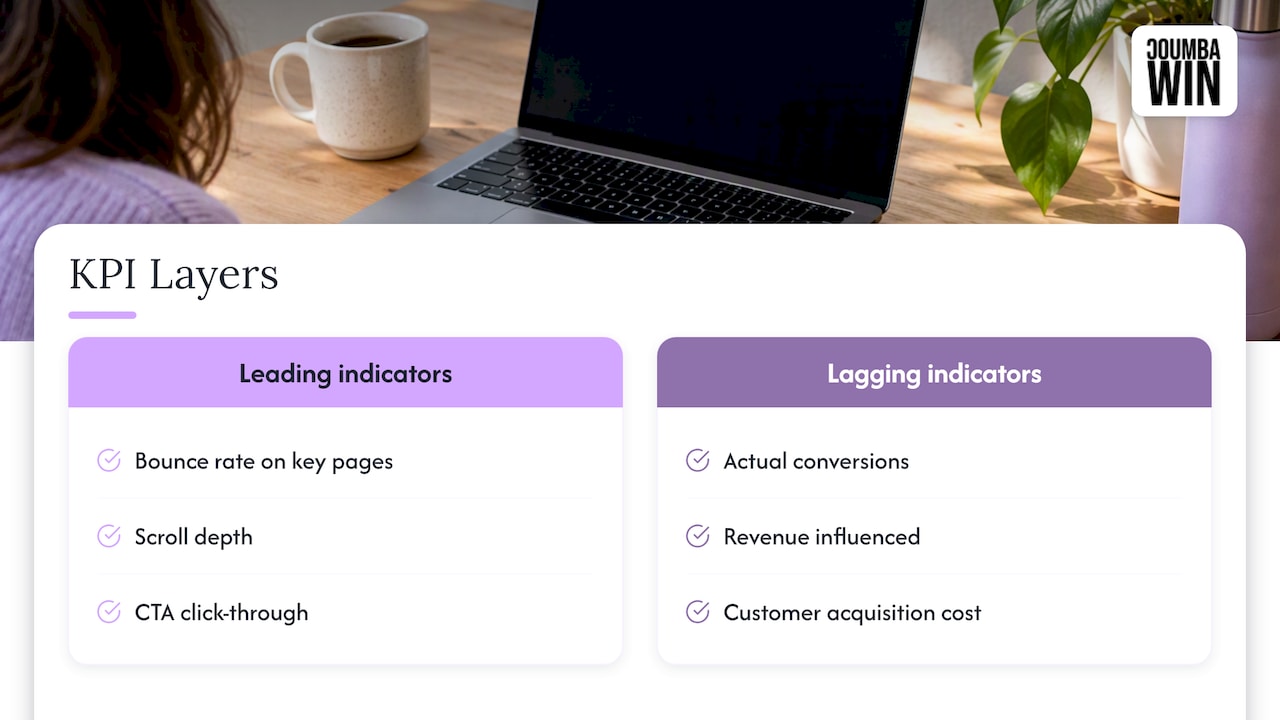
From there, KPIs break into two layers. Leading indicators (bounce rate on key pages, scroll depth, click through on a CTA) tell you whether a change is working early. Lagging indicators (actual conversions, revenue influenced, customer acquisition cost) tell you whether it mattered. Track both, because a leading indicator can look great while the lagging number stays flat, and that gap is often one of the most useful things you learn.
Set a baseline before you touch anything. Without knowing where you started, a lift is just a number with no story behind it. Review KPIs on the same cadence as your sprints, not quarterly, so you can kill underperforming experiments before they waste another cycle. And resist the urge to track everything: five focused metrics beat twenty vague ones every time.
Getting Stakeholders Actually Involved (Not Just Informed)
Nothing kills a GDD process faster than a founder who disappears for six weeks and then vetoes everything in the review meeting. The fix is building collaboration into the structure itself rather than hoping it happens naturally.
Start the strategy phase with stakeholders in the room, not just the design and marketing team. Sales knows what objections keep showing up on calls. Customer support knows what confuses people post sign up. Those insights belong in your hypothesis list from day one.
Keep a shared, visible wishlist and backlog so nobody is surprised by what’s being tested. A recurring sprint review, even a short one, where the team shows what was tested, what won, and what’s next, keeps stakeholders bought in because they’re watching the site improve in real time instead of waiting for a big reveal. That visibility is often what turns a skeptical founder into the person pushing for more experiments, not fewer.
Where SEO Fits Into Continuous Improvement
SEO isn’t a one time setup task in GDD, it’s a recurring line item on the experiment backlog. Every sprint is a chance to test a page title, tighten up internal linking, or restructure a page’s headings based on what’s actually ranking and what isn’t.
The advantage over a traditional redesign is timing. A full redesign often resets a site’s SEO equity overnight: new URLs, new templates, sometimes lost rankings that take months to recover. GDD avoids that cliff because changes roll out incrementally, page by page, so you can watch rankings and organic traffic respond to each change instead of guessing what caused a drop six months later.
Treat SEO experiments the same way you’d treat a conversion test: hypothesis, change, measure, scale or kill. A new meta description might be tested alongside a CTA change on the same page, since both can move toward the same focus metric. Over time, this turns SEO from an occasional audit into an ongoing habit baked into the same sprint cadence as everything else.
User Research and Testing Done Right
The strategy phase sets the research foundation, but the real value of user research in GDD is that it never stops. Interviews, surveys, and usability tests keep feeding the backlog long after launch, because new features and new visitors always surface new friction.
A few habits make this work better. Talk to actual users, not just your internal team’s guesses about what users want. Pair qualitative research (the “why”) with quantitative data like heatmaps and session replays (the “where”), since one without the other tells half the story. Methods like A/B testing, heatmaps, and session recordings help reveal exactly where visitors lose interest and which design changes actually move conversions.
Test early and test small. A usability test on a new checkout flow before it ships can catch problems that analytics sessions might only reveal after the damage is done.
GDD and the Startup Growth Curve
Startups don’t have the luxury of a static website, because the business underneath it keeps changing shape. What a pre seed startup’s site needs to communicate is nowhere close to what it needs once there’s product market fit and a sales team to support. GDD flexes with that curve instead of forcing a rebuild every time the business pivots.
Early on, the launch pad approach matters most: get a credible, fast site live without burning months of runway on features nobody’s validated yet. As traction builds, the focus metric shifts, maybe from waitlist sign ups to demo requests to self serve trial activations, and the experiment backlog shifts right along with it. Nothing about the underlying site structure has to be torn down and rebuilt each time, because GDD was never meant to be “finished” in the first place.
That adaptability is really the whole point. A site built through GDD scales its priorities alongside the company instead of becoming outdated the moment the business outgrows it. For startups building a bold web presence, this means the site can keep pace with fundraising, product launches, and audience growth without an expensive redesign every time strategy shifts. Teams that want to extend that growth work into broader audience engagement strategies often find the same testing mindset applies well beyond the website itself.

Our Take on GDD for Startups
We lean on GDD because outcome oriented design only works when it’s tested, not guessed at. Our work comes from treating every launch as a starting point, not a finish line. Hiring a partner makes the most sense once you need speed and structure without building an internal growth team from scratch.
— Coumba Evelyn
Ready to Put GDD to Work? Here’s How We Can Help
If reading all of this made you think “great, now who actually builds this,” that’s exactly where we come in. We handle web design and development, UX/UI design, Webflow development, and ongoing support for startups that want to keep improving their site instead of waiting for the next redesign.
Running experiments internally works great once you’ve got the team and the bandwidth. If you don’t, or you’d rather spend that time building your product instead of your site’s heatmap setup, that’s when bringing in a partner tends to pay off fastest. We work directly with founders who see design as a growth lever, not just a coat of paint, and our services page is the fastest way to start that conversation or see how past projects played out.
FAQ
What is growth-driven design?
Growth driven design is an iterative website methodology that replaces a single large redesign with a fast initial launch followed by ongoing, data backed improvement cycles. It’s built around testing real user behavior rather than guessing what a redesign should include.
What are the three stages of growth driven design?
The three stages are strategy, launch pad, and continuous improvement. Strategy sets goals and a roadmap, the launch pad gets a leaner site live quickly, and continuous improvement runs ongoing experiment sprints to refine the site over time, as described in GDD overviews from industry guides.
What is the GDD methodology?
The GDD methodology treats a website like an evolving product rather than a one time project, using research, hypotheses, and measured experiments to guide every change. It draws on the same observation and experimentation mindset used in growth design practice.
What is the GDD process?
The GDD process starts with a strategy phase to define goals and personas, moves into a launch pad build to get a working site live fast, and then runs recurring sprint cycles where experiments are tested, measured, and scaled or discarded. Each cycle feeds a prioritized backlog that keeps the site improving instead of sitting static between redesigns.
How is GDD different from a traditional website redesign?
A traditional redesign bets a large budget and a long timeline on one launch, with no built-in way to learn from real user behavior until it’s already live. GDD spreads that risk across smaller, faster cycles, validating changes with data before they become permanent and avoiding the SEO and conversion cliffs a full relaunch can cause.